
Which FOIA requests reveal how a government office actually works?
Requests for recurring internal reports, agency-held White House email, distribution lists, and intranet pages show how an office works. Four weekly reports from the Defense Department inspector general’s lawyers, released under FOIA, count 157 subpoenas in four weeks of April 2024, about half for basic subscriber information, and 559 in one quarter.
- Recurring internal reports, agency-held White House email, distribution lists, and intranet pages show how federal offices work, and each can be requested by date range, custodian, or name.
- Four weekly reports from the Defense Department inspector general’s lawyers, released under FOIA, count 157 inspector general subpoenas over four weeks of April 2024.
- In those four weeks, 79 of the 157 subpoenas, about half, were for basic subscriber information, according to the tables’ footnotes.
- The office reported 559 subpoenas issued in the second quarter of fiscal 2024, 221 of them for the Army’s criminal investigators, and 969 for the first half of the fiscal year.
- Crimes against persons accounted for 254 of the quarter’s subpoenas, or 45%.
- The categories behind each week’s count, and most legal advice in the reports, were withheld under exemption (b)(5).
- Copies of White House email held by agencies can be requested under FOIA; one released email sent talking points to Cabinet members with its addressees left unredacted.
- A Small Business Administration release shows a White House invitation addressed to four distribution lists, one printed in full as DLOPSODepartment@WHO.eop.gov.
- Justice Department intranet screenshots name internal systems and collections and end with an unredacted Justice Management Division sitemap.
Final reports tell the public what an office concluded. Recurring internal reports, group mailing lists, and internal web pages show how it got there: who asked for what, how often, who is on the distribution, and which systems the staff uses. These records are written on a schedule or kept in predictable places, and they can be requested by date range, custodian, or name, which makes them productive targets under the Freedom of Information Act.
This guide covers four record types, each drawn from a release obtained under FOIA: weekly activity reports from the Defense Department’s Office of Inspector General, White House email held by the Office of the U.S. Trade Representative, a White House distribution-list invitation held by the Small Business Administration, and intranet pages from the Justice Department’s Justice Management Division. The Defense Department release consists of four weekly activity reports that the inspector general’s Office of General Counsel sent to the inspector general in April 2024, and its 18 released pages count subpoenas week by week, by requesting agency, and by type of investigation. (record)
Editor’s note: The DoD records, case DODOIG-2024-000442, were obtained under FOIA and are hosted with this guide. OctoProbe blacked out the requester’s name, email address, and street address on the response letter; every other redaction is the agency’s. The other three records are hosted as released, compressed for the web; none contained requester information. Page citations give the page of the hosted PDF.
Type 1: Inspector General Weekly Activity Reports and Info Memos
A weekly activity report is a short memo in which an office tells its leadership what it did that week and what is coming. In the Defense Department inspector general’s office, the general counsel’s weekly reports went to the inspector general as “INFO MEMO” documents titled “Weekly Activity Report” for a stated date range. (record) Each released report follows the same outline: “Priorities,” “Significant Activities and Events,” “90 Day Outlook,” “Other Issues and Matters of Interest,” “Weekly Subpoena Support,” and “Personnel Actions.” (record)

Transcription Weekly Activity Report for April 1, 2024 to April 5, 2024 (PDF p. 3)
“INFO MEMO … April 5, 2024 … FOR: INSPECTOR GENERAL … FROM: Paul Hadjiyane, General Counsel … SUBJECT: Weekly Activity Report for April 1, 2024 to April 5, 2024”
“Priorities: MOU with [withheld, (b)(5)]: We completed our revised comments on [withheld, (b)(5)] … We plan to schedule an additional meeting to discuss.”
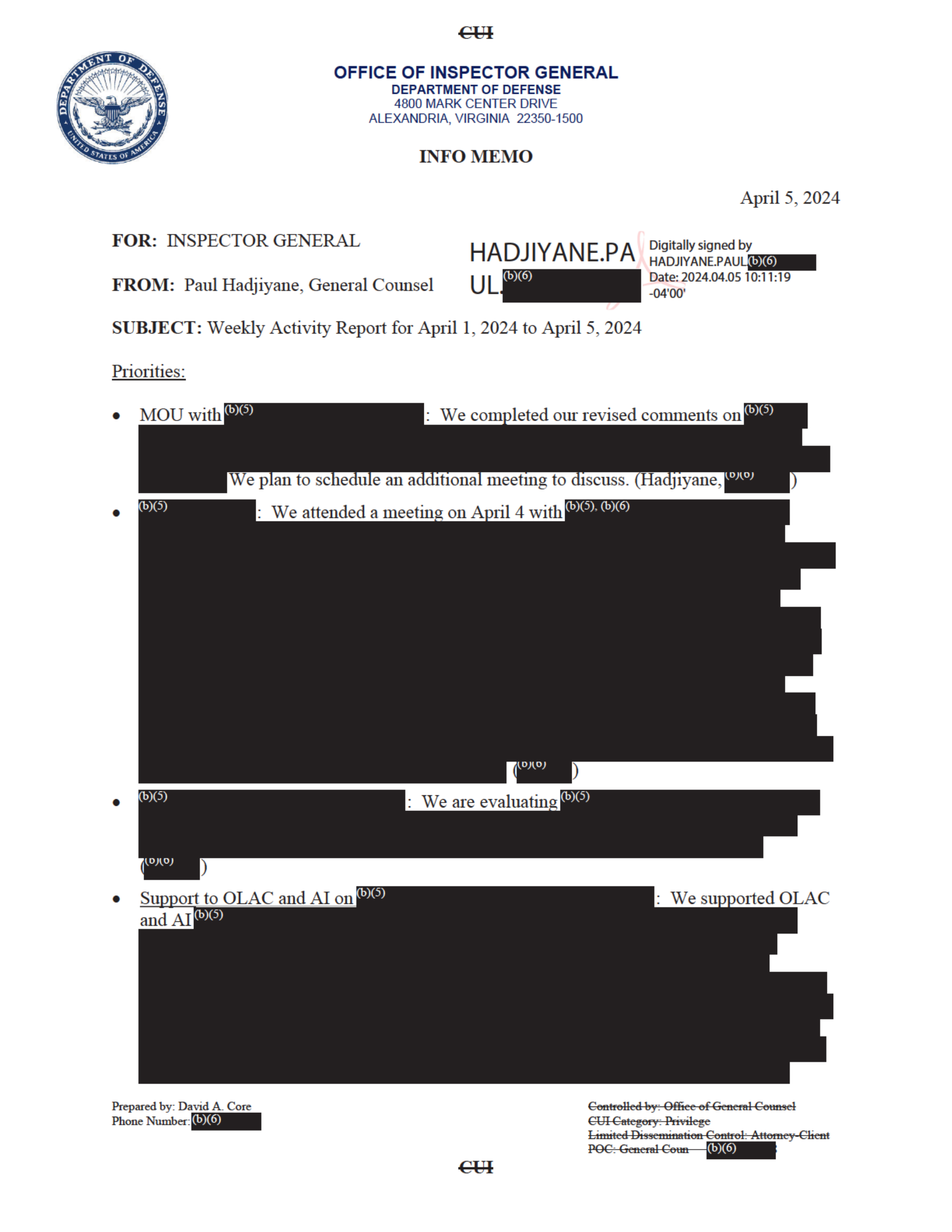
The April 2024 reports were signed by Paul Hadjiyane, general counsel, for the weeks of April 1, April 8, and April 15, and by David A. Core, principal deputy general counsel, for the week of April 22. Each lists Core as the preparer. (record) Requests for them go to the Defense Department inspector general’s FOIA office, which processes requests for the inspector general’s own records and says it does not handle requests for the rest of the department. (FOIA)
Because each report is dated and repeats the same sections, a run of them can be lined up week against week. The most useful recurring section in this release is the subpoena table. Every report includes a “Weekly Subpoena Support” table listing a count for each Defense Department investigative agency, and the four April 2024 tables total 35, 31, 36, and 55 subpoenas. (record) Each table’s footnote gives the number “of the total issued subpoenas” that were “for Basic Subscriber Information”: 14, 20, 20, and 25. (record)
Added together, the tables count 157 subpoenas over the four weeks, 79 of them, or 50%, for basic subscriber information. In the week of April 8, 20 of 31 subpoenas, or 65%, were for subscriber information. The records do not say whether the weekly tables capture every subpoena the office issued in a given week.

Transcription Weekly Subpoena Support, report dated April 12, 2024 (PDF p. 11)
“CID – 17 … OSI – 6 … DFAS – 3 … USMC CID – 2 … DCIS – 1 … NCIS – 1 … DES MPI – 1 … TOTAL – 31”
“** 20 of the total issued subpoenas were for Basic Subscriber Information”
Number and Category: [withheld, (b)(5)]
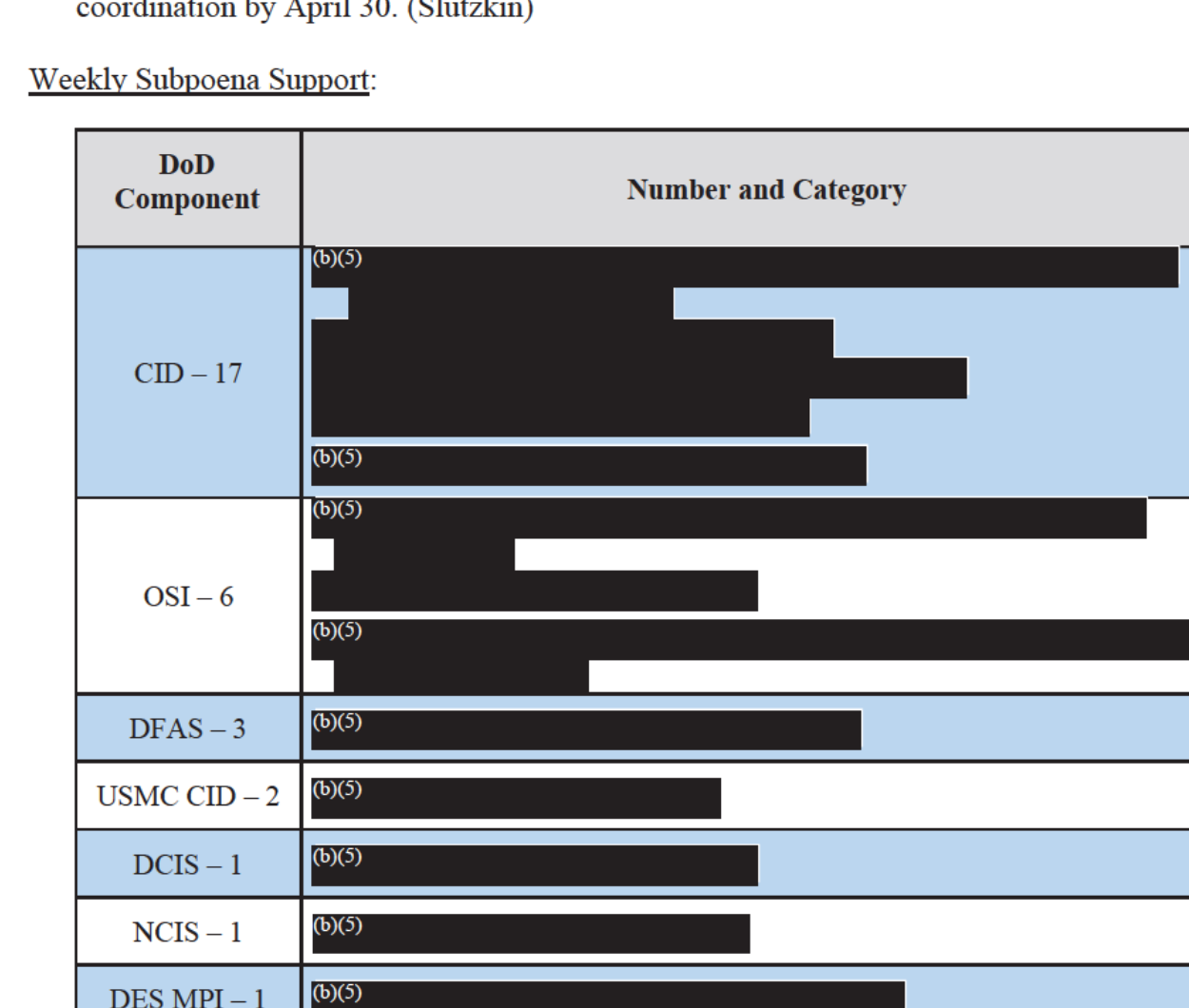

The Army’s criminal investigators were the largest requester in three of the four weeks, peaking at 37 in the report dated April 26. In the week of April 15, the Air Force Office of Special Investigations led with 16. (record)
| Week | Report dated | From | Subpoenas by component, as printed | Total | Basic subscriber information | Record |
|---|---|---|---|---|---|---|
| Apr. 1–5 | Apr. 5 | Paul Hadjiyane, general counsel | Army CID (USACIDC) 13, OSI 6, DFAS 5, DCIS 3, NCIS 3, DES MPI 3, PFPA 2 | 35 | 14 | pp. 5–6 |
| Apr. 8–12 | Apr. 12 | Paul Hadjiyane, general counsel | CID 17, OSI 6, DFAS 3, USMC CID 2, DCIS 1, NCIS 1, DES MPI 1 | 31 | 20 | p. 11 |
| Apr. 15–19 | Apr. 19 | Paul Hadjiyane, general counsel | OSI 16, Army CID (USACIDC) 10, NCIS 5, DES MPI 3, DFAS 2 | 36 | 20 | pp. 15–16 |
| Apr. 22–26 | Apr. 26 | David A. Core, principal deputy general counsel | Army CID (USACIDC) 37, OSI 15, DCIS 2, DFAS 1 | 55 | 25 | p. 19 |
| April 1–26 | Four reports | Army CID 77, OSI 43, DFAS 11, NCIS 9, DES MPI 7, DCIS 6, PFPA 2, USMC CID 2 | 157 | 79 | OctoProbe sum |
Component labels vary between reports (CID, USACIDC); both refer to the Army’s criminal investigators. The April 12 report’s subject line reads “April 8, 2024 to March 12, 2024,” as printed. The “Number and Category” column is withheld under (b)(5) in every week.

Transcription Weekly Subpoena Support, report dated April 26, 2024 (PDF p. 19)
“USACIDC – 37 … OSI – 15 … DCIS –2 … DFAS – 1 … TOTAL – 55”
“**25 of the total issued subpoenas were for Basic Subscriber Information”
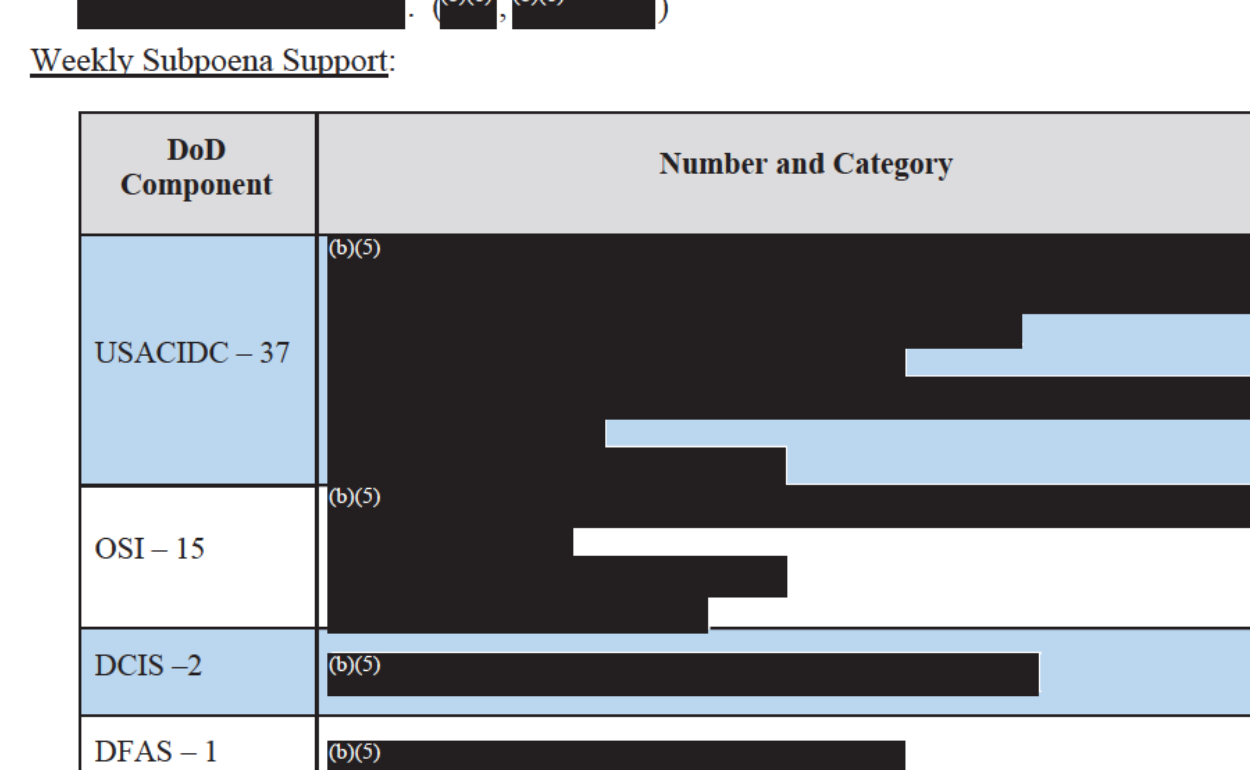
The “Number and Category” column, which describes what each subpoena was for, is blacked out in every week and marked (b)(5), the exemption for privileged inter- and intra-agency communications. (record)
The April 5 report also carries quarterly statistics. A chart titled “DOD IG SUBPOENAS ISSUED - 2nd QUARTER FY 2024,” dated “AS OF: 4/4/2024,” gives a total of 559 for January through March 2024. (record) The bullet above it reads “Q1 and Q2 total = 969 issued subpoenas.” (record) Subtracting the second quarter from that total leaves 410 subpoenas for October through December 2023, a figure the record does not state. The second-quarter total works out to about 43 subpoenas a week over 13 weeks, against the 39 a week averaged in the four April tables.

Transcription FY 2024 Q2 Subpoena Statistics, report dated April 5, 2024 (PDF p. 6)
“FY 2024 Q2 Subpoena Statistics (Q1 and Q2 total = 969 issued subpoenas)”
“DOD IG SUBPOENAS ISSUED - 2nd QUARTER FY 2024 … TOTAL = 559 … AS OF: 4/4/2024” — CID, 221, 40%; OSI, 117, 21%; NCIS, 66, 12%; DCIS, 53, 9%; DFAS, 41, 7%; USAF SFI, 25, 4%; USMC CID, 20, 4%; DES MPI, 9, 2%; PFPA, 5, 1%; OTHER, 2, 0%
“Q2 Subpoenas by Type of Investigation: 254 – Crimes Against Persons (45%) … 76 – Procurement Fraud (14%) … 21 – Public Corruption and National Security (4%) … 127 – Theft of Private or Government Property/Funds (23%) … 81 – Other Crimes (e.g., pay fraud, computer crime) (14%)”
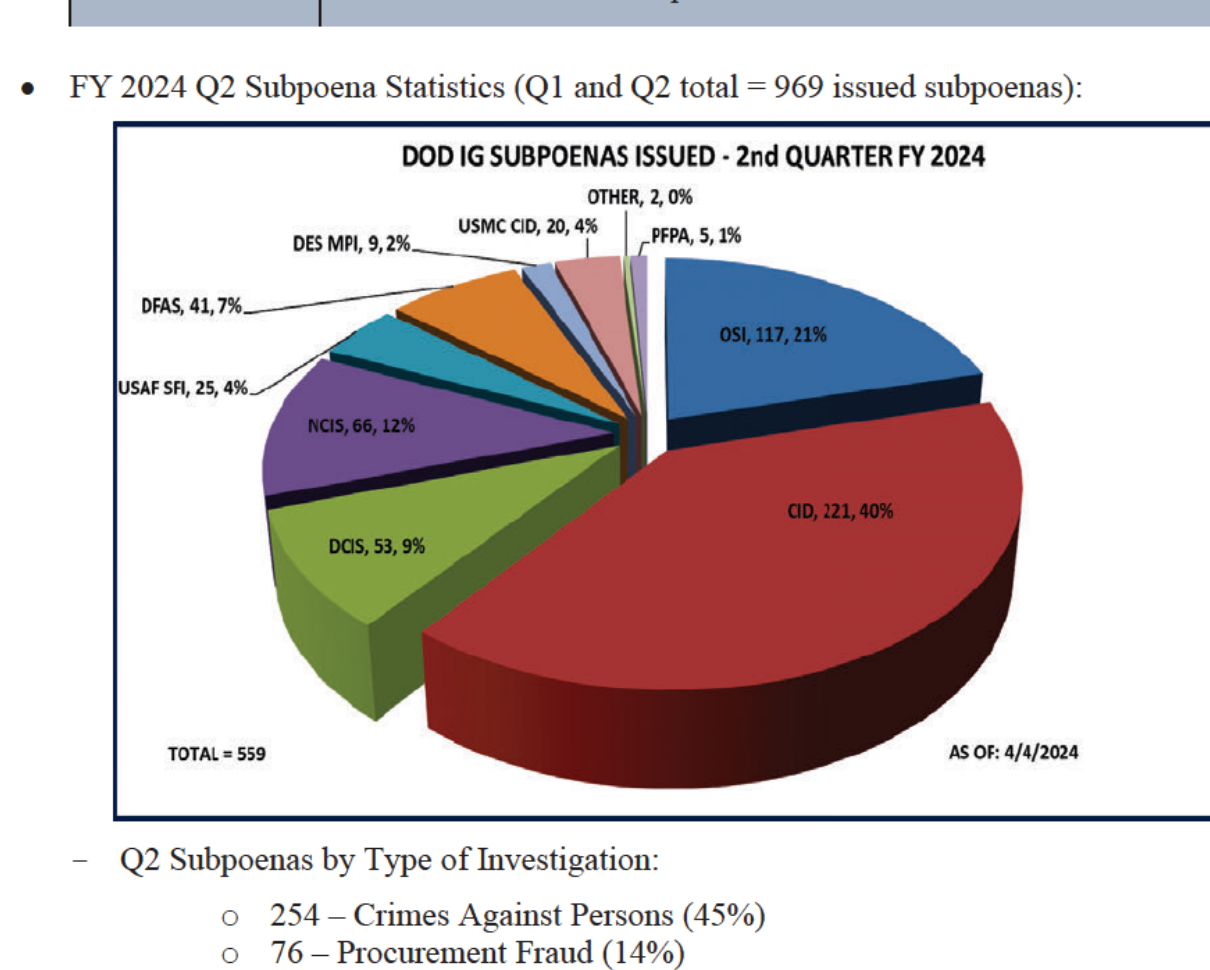
By requesting agency, the Army’s criminal investigators accounted for 221 of the quarter’s subpoenas, or 40%, followed by the Air Force Office of Special Investigations with 117 and the Naval Criminal Investigative Service with 66. The inspector general’s own Defense Criminal Investigative Service accounted for 53. (record)

By type of investigation, crimes against persons led with 254 subpoenas, or 45%. Theft of private or government property or funds accounted for 127, other crimes “(e.g., pay fraud, computer crime)” 81, procurement fraud 76, and public corruption and national security 21. (record)

The labels in the record are abbreviations. Most are Defense Department criminal investigative or law enforcement organizations; DFAS is the department’s finance and accounting agency. Two labels are not expanded in the release.
| Label in the record | Organization | Source |
|---|---|---|
| CID, USACIDC | U.S. Army Criminal Investigation Division (formerly Command) | Army |
| OSI | Air Force Office of Special Investigations | AFOSI |
| NCIS | Naval Criminal Investigative Service | NCIS |
| DCIS | Defense Criminal Investigative Service, the inspector general’s own criminal investigators | OIG |
| DFAS | Defense Finance and Accounting Service | DFAS |
| USMC CID | U.S. Marine Corps Criminal Investigation Division | Marines |
| USAF SFI | Not expanded in the record; Air Force Security Forces investigators work installation cases | Nellis |
| DES MPI | Not expanded in the record; on Army installations, military police investigators work under a Directorate of Emergency Services | Huachuca |
| PFPA | Pentagon Force Protection Agency | PFPA |
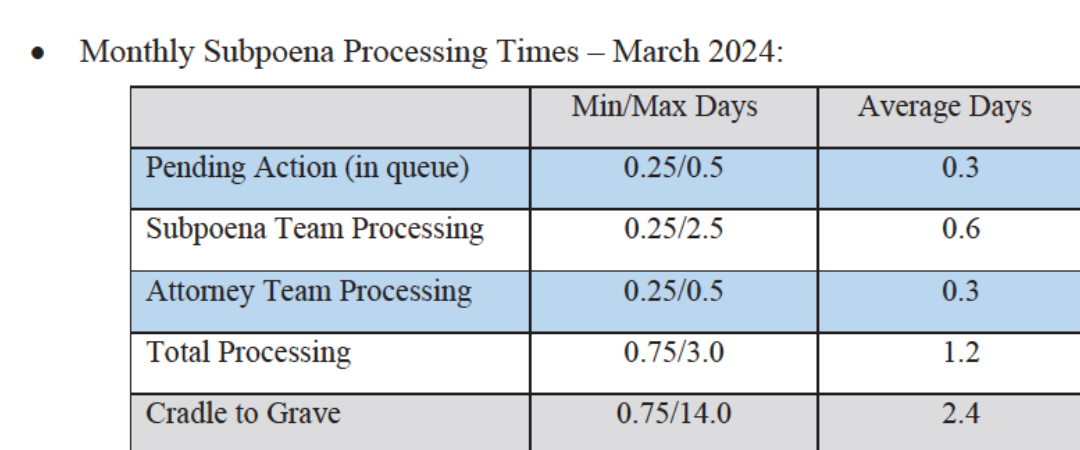
The same report tracks speed. A “Monthly Subpoena Processing Times” table for March 2024 puts the average total processing time at 1.2 days and the average “Cradle to Grave” time at 2.4 days, with a maximum of 14 days. A note says the “Calculation excludes weekends and holidays.” (record)

Transcription Monthly Subpoena Processing Times – March 2024, report dated April 5, 2024 (PDF p. 7)
“Pending Action (in queue) 0.25/0.5 · 0.3 — Subpoena Team Processing 0.25/2.5 · 0.6 — Attorney Team Processing 0.25/0.5 · 0.3 — Total Processing 0.75/3.0 · 1.2 — Cradle to Grave 0.75/14.0 · 2.4”
“*Calculation excludes weekends and holidays.”
The report also says the office “provided training to 177 DCIO Investigators in March 2024,” referring to Defense criminal investigative organizations. (record) The April 12 report lists training at the Federal Law Enforcement Training Centers on April 23 “on requesting and obtaining subpoenas and other criminal law matters.” (record)
The subpoenas rest on the Inspector General Act, now codified at 5 U.S.C. § 406, formerly Section 6 of the 1978 act. It lets an inspector general “require by subpoena the production of all information, documents, reports, answers, records, accounts, papers, and other data in any medium,” enforceable in federal district court, but directs that “procedures other than subpoenas” be used to get records from federal agencies. (statute) At the Defense Department, “The Subpoena Program Director administers all subpoena requests by the Defense Criminal Investigative Organizations (DCIOs),” according to the inspector general’s website. (OIG)
The released reports do not define “Basic Subscriber Information.” Federal law lists the subscriber records that a provider of electronic communication or remote computing service must disclose when the government uses “an administrative subpoena authorized by a Federal or State statute”: name; address; connection records or “records of session times and durations”; length and types of service; subscriber numbers or identities, “including any temporarily assigned network address”; and “means and source of payment.” (law) The same section says the government “is not required to provide notice to a subscriber or customer.” (law) Where these requests sit among other legal process is covered in a separate guide.
The reports name few investigative subjects. Under “Significant Activities and Events,” the April 19 report lists “Support to ISO in [withheld] Investigation,” saying office lawyers “spoke with the investigative team” and are “consulting with ISO on next steps.” (record) ISO is the inspector general’s Investigations of Senior Officials directorate. (OIG) The April 26 report says the lawyers “reviewed the comments from IGFO on the draft ROI,” a report of investigation whose subject is withheld under (b)(6), “and met with ISO to discuss.” (record)
Other released items include a case in federal district court in Washington, its name withheld, in which the office is “working with DoD OGC and the DC USAO to determine next steps,” and Day v. DoD, a FOIA lawsuit in which “The court ordered the OIG to review redactions taken under exception 7(D)” on 10 pages of records. (record) The April 19 and April 26 reports also list the “Audit of DoD’s Implementation of the Defense Cooperation Agreement (DCA) with the State of Kuwait (Project No. D2024-D000RJ-0080.00),” with the substance withheld. (record) Repeated entries cover legal support to the Office of Legislative Affairs and Communications, the inspector general’s congressional and media office, and to Administrative Investigations. (record) (OLAC)
Staffing appears in every report. The general counsel’s office listed 41 civilian positions under “AES (UpperLimit)” and an “End Strength” of 37, with four accepted offers by April 19. (record) Each of these items, from a named audit to a withheld investigation title, is a lead that a narrower follow-up request can cite by name and date.
The request behind this release sought “[a]ll Weekly Activity Reports (or Info Memos) or finalized weekly reporting to the DOD Inspector General from the Office of General Counsel” for April 2024. (record) The office received it April 29, 2024, and answered July 10, 2024. (record) A follow-up can name the same office, recipient, record type, and a short window, for example “all finalized weekly activity reports, info memos, or other recurring weekly reporting submitted to the Inspector General by the Office of General Counsel between [start date] and [end date], including attachments, tables, and charts.” Asking for “finalized” versions steers the search away from drafts, which agencies often withhold as deliberative, and a window of a month or a quarter makes gaps between requests easy to spot. Filing basics are covered in a separate how-to.
Fees and speed are set by statute. For a representative of the news media, fees are limited to “reasonable standard charges for document duplication.” (statute) A requester can seek expedited processing by showing a “compelling need,” which for a person primarily engaged in disseminating information includes an “urgency to inform the public concerning actual or alleged Federal Government activity.” (statute) The inspector general’s response said an appeal “must be postmarked within 90 days of the date of this letter” and pointed requesters to its FOIA Public Liaison and to the Office of Government Information Services at the National Archives. (record) (OGIS) The department’s FOIA appeal rules are in 32 C.F.R. part 286. (eCFR)
The response withheld information under (b)(5), “certain inter-and intra-agency communications protected by the attorney-client privilege and the deliberative process privilege,” and (b)(6), information whose release “would constitute a clearly unwarranted invasion of personal privacy.” (record) In practice, (b)(5) covered the substance of most legal advice and every subpoena category, while (b)(6) covered staff names, phone numbers, and the names in investigation titles. (record) The letter said the review applied the “foreseeable harm standard,” which the FOIA statute writes as withholding only where “the agency reasonably foresees that disclosure would harm an interest protected by an exemption.” (record) (statute)
Reports that touch open cases can also draw the law enforcement exemptions in 5 U.S.C. § 552(b)(7), including (A), records that “could reasonably be expected to interfere with enforcement proceedings”; (C), an “unwarranted invasion of personal privacy”; and (E), records that “would disclose techniques and procedures for law enforcement investigations or prosecutions.” (statute) None of the (b)(7) exemptions was cited in this release. The letter carried the standard exclusion notice: “Congress excluded three discrete categories of law enforcement and national security records from the requirements of the FOIA. See 5 U.S.C. 552(c).” The office called it “a standard notification that is given to all our requesters.” (record) The Justice Department’s FOIA guide covers the exclusions in a separate chapter. (DOJ)
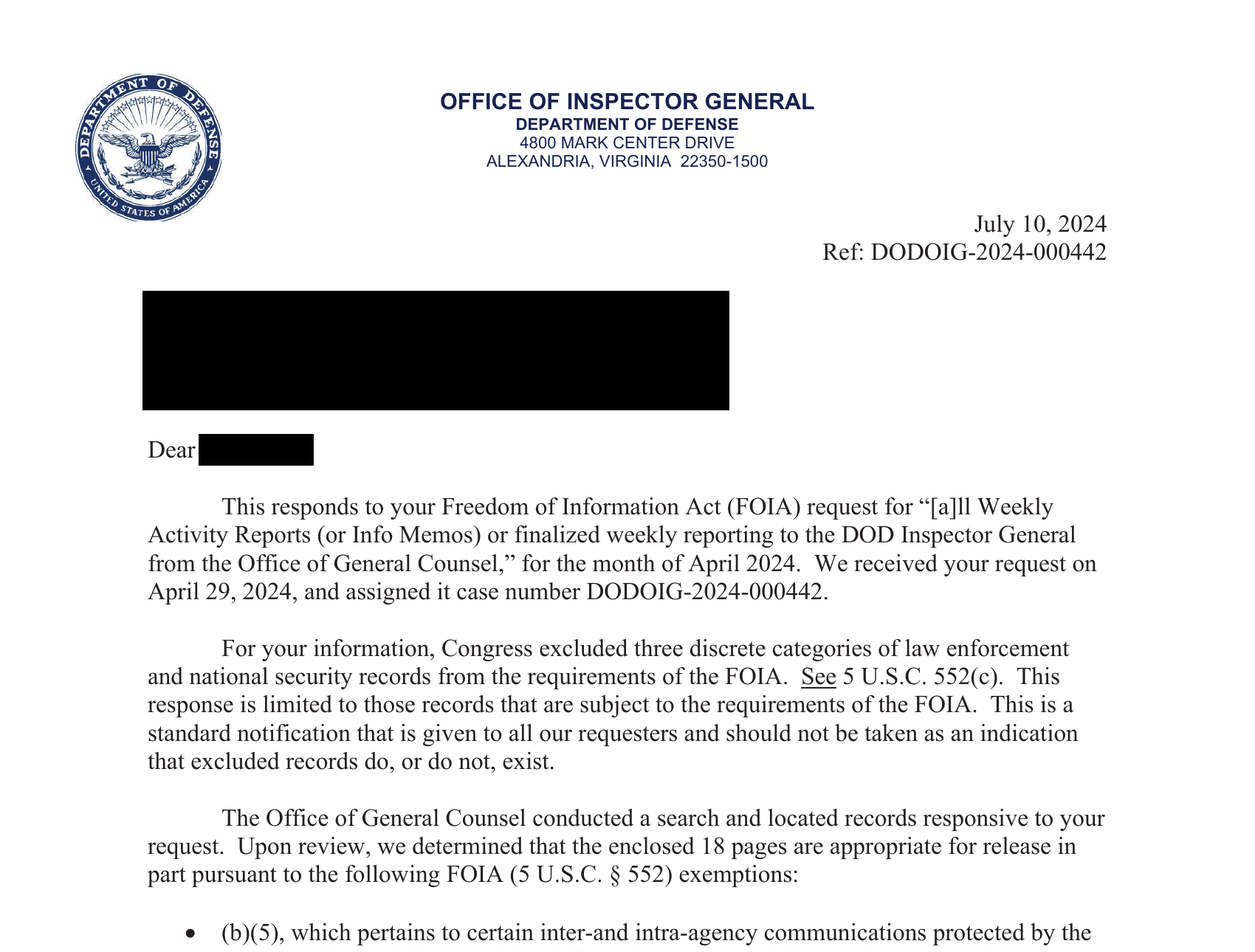
The full response ran 20 pages: a two-page letter and 18 pages of records released in part, the four weekly activity reports dated April 5, 12, 19, and 26, 2024. (record) The letter was signed by Mark Dorgan, director of the inspector general’s FOIA, Privacy and Civil Liberties Office. (record)

Transcription DODOIG-2024-000442, response letter, July 10, 2024 (PDF p. 1)
“This responds to your Freedom of Information Act (FOIA) request for ‘[a]ll Weekly Activity Reports (or Info Memos) or finalized weekly reporting to the DOD Inspector General from the Office of General Counsel,’ for the month of April 2024.”
“Upon review, we determined that the enclosed 18 pages are appropriate for release in part pursuant to the following FOIA (5 U.S.C. § 552) exemptions: (b)(5) … and (b)(6) …”
The subpoena counts in the weekly reports do not appear in the inspector general’s public semiannual report for the same period. A text search of the October 2023 to March 2024 report to Congress finds no use of the word “subpoena.” (SAR)
Type 2: White House Emails, Requested From the Agency Side
Email that the White House Office, the Office of the Vice President, and other parts of the Executive Office of the President exchange with department and agency officials can be requested from the agency’s copy rather than from the White House. The White House Office’s own files generally sit outside FOIA. The Justice Department’s FOIA guide says the Office of the President, including the “President’s immediate personal staff or units in the Executive Office whose sole function is to advise and assist the President,” is not an agency under FOIA. (guide) An earlier edition of the guide traces that line through Kissinger v. Reporters Committee for Freedom of the Press, Meyer v. Bush, and Armstrong v. Executive Office of the President. (guide)
Those offices’ records fall under the Presidential Records Act, which covers materials “created or received by the President, the President’s immediate staff, or a unit or individual of the Executive Office of the President whose function is to advise or assist the President.” The same definition excludes “official records of an agency.” (statute) A copy of a White House email that reaches a department is therefore generally a record of that department, outside the Presidential Records Act, and requesters can ask the department for it.
Some units inside the Executive Office are agencies in their own right. The Justice Department’s guide names the Office of Management and Budget and the Office of Science and Technology Policy among them. (guide) The Office of the U.S. Trade Representative, whose addresses end in ustr.eop.gov, runs its own FOIA office under a published rule. (rule) There are limits: the Justice Department’s guide cites a federal appeals court ruling that White House visitor logs held by the Secret Service were not “agency records.” (guide)
At a receiving agency, such email usually passes through the offices of the secretary or agency head, the chief of staff, and the executive secretariat, which route correspondence. The trade representative’s FOIA rule asks requesters seeking correspondence to name “the subject matter and the relevant parties with contact information such as their email addresses.” (rule)
The release from the trade representative’s office runs 59 pages of email and attachments from Trade Representative Katherine Tai’s account, dated from December 2023 through January 2024, released in part. (record) It shows what the White House tells the Cabinet, in what words, and when. One email is a January 9, 2024, memorandum to Cabinet members from White House Chief of Staff Jeff Zients on “Cabinet Notifications,” sent with the note “Please see attached, which requires your immediate attention and response.” (record) The memo directs agencies to submit their delegation-of-authority protocols to the White House Office of Cabinet Affairs by January 12, 2024. (record)

Transcription Talking Points on the Conflict in the Middle East, January 24, 2024 (PDF p. 18)
“From: ‘Ryan, Evan M. EOP/WHO’ … Cc: ‘Grant, Sheila B. EOP/WHO’ … ‘Rastegar, Sanam EOP/WHO’ … Date: Wed, 24 Jan 2024 17:57:51 -0500”
“Cabinet members, I know that many of you are getting questions on the conflict in the Middle East, so I wanted to make sure that you have the latest talking points at your disposal.”
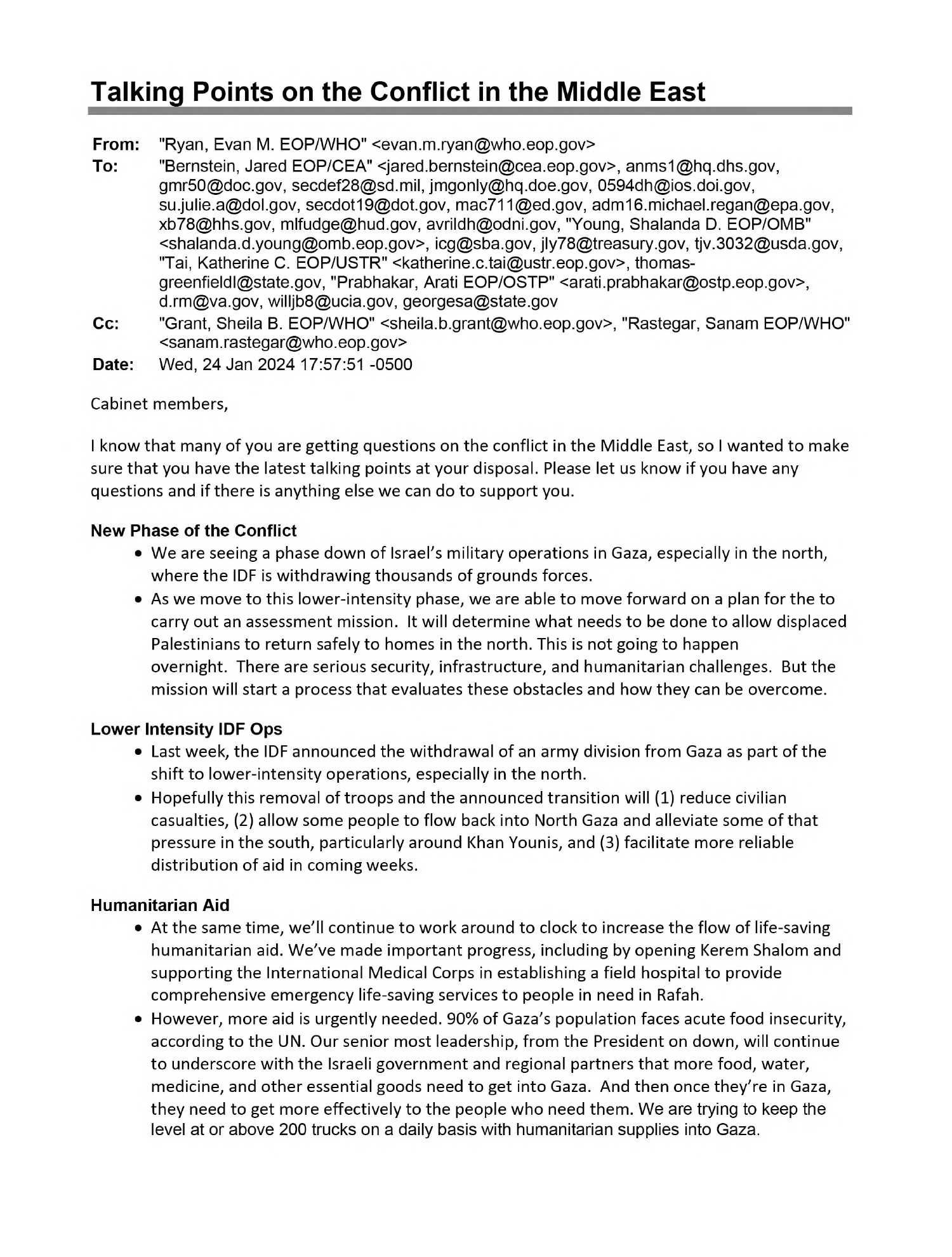
Another email, sent January 24, 2024, at 5:57 p.m., carries “Talking Points on the Conflict in the Middle East” from Evan M. Ryan of the White House Office to “Cabinet members.” (record) Ryan is identified as Cabinet secretary in the January 9 memo. (record) The distribution names four officials: Jared Bernstein of the Council of Economic Advisers, Shalanda D. Young of the Office of Management and Budget, Katherine C. Tai of the trade representative’s office, and Arati Prabhakar of the Office of Science and Technology Policy. Sheila B. Grant and Sanam Rastegar of the White House Office are copied. (record)
The other addressees appear only as bare addresses at the departments of Homeland Security, Commerce, Defense, Energy, the Interior, Labor, Transportation, Education, Health and Human Services, Housing and Urban Development, the Treasury, Agriculture, State, and Veterans Affairs, and at the Environmental Protection Agency, the Office of the Director of National Intelligence, the Small Business Administration, and the CIA. (record)
The heads of those agencies that week included Alejandro Mayorkas at Homeland Security, Gina Raimondo at Commerce, Lloyd Austin at Defense, Jennifer Granholm at Energy, Deb Haaland at the Interior, Julie Su as acting secretary of labor, Pete Buttigieg at Transportation, Miguel Cardona at Education, Xavier Becerra at Health and Human Services, Janet Yellen at the Treasury, Tom Vilsack at Agriculture, Denis McDonough at Veterans Affairs, Michael Regan at the EPA, Avril Haines at the ODNI, Isabel Guzman at the SBA, William Burns at the CIA, and Linda Thomas-Greenfield as ambassador to the United Nations, according to the White House Cabinet page as archived January 24, 2024. (Cabinet) Marcia L. Fudge was housing secretary until her resignation took effect March 22, 2024. (HUD) The talking points themselves refer to “Secretary Blinken.” (record)
The Homeland Security address, anms1@hq.dhs.gov, is Secretary Alejandro N. Mayorkas’s distribution address; its letters match his initials. (Congress) The ODNI address, avrildh@odni.gov, is the address of Avril Haines, then the director of national intelligence. (Cabinet) The agency left these addressees unredacted on the talking-points email, while it withheld most email addresses elsewhere in the same release under Exemption 6. (record)
An address list like this one identifies custodians for later requests, since each address is a mailbox an agency can be asked to search. A request to a department can name the custodians, the date range, and the White House domains, and ask for the agency’s own copies with full header information, for example all emails sent to or received by “[the Secretary], [the Chief of Staff], and [the Executive Secretariat] between [start date] and [end date] in which the To, From, Cc, or Bcc field contains an address ending in ‘@who.eop.gov,’ ‘@ovp.eop.gov,’ or ‘@eop.gov.’” Asking for the agency’s own copies keeps the request on records the department holds, which are outside the Presidential Records Act.
This release marks its withholdings “EXEMPTION 5,” “EXEMPTION 6,” and “EXEMPTIONS 5, 6,” for deliberative material and for names and addresses. (record) Requests that touch White House material can also take time for consultation. An April 15, 2009, memo from White House Counsel Gregory Craig told agencies they “should consult with the White House Counsel’s Office on all document requests that may involve documents with White House equities,” including FOIA requests. (memo) The Justice Department’s Office of Information Policy describes consultation as the usual practice when a record “contain[s] within [it] information of interest to another agency.” (OIP) The file as released contains no response letter.
Type 3: Distribution Lists That Reach Core Staff
Email distribution lists are the group addresses an office uses to reach a whole staff or a class of employees at once. A request that names a list address as a search term can return everything sent to that group in a custodian’s mailbox, and every mailbox that receives list traffic holds a copy, so agency staff on a White House list, or senior officials on an agency’s own list, have records their agency can search.
Some lists are built around employee categories. The Senior Executive Service “includes most managerial, supervisory, and policy positions classified above General Schedule (GS) grade 15 or equivalent positions in the Executive Branch,” according to the Office of Personnel Management. (OPM) Political appointees are catalogued in the Plum Book, which “lists over 7,000 Federal civil service leadership and support positions” that “may be subject to noncompetitive appointment.” (Plum)
The Small Business Administration released five pages: the invitation, its forwarded copy, and the calendar details. A banner on the second page reads “CAUTION - The sender of this message is external to the SBA network.” (record) The invitation, from Rachel I. Chiu of the White House Office and dated February 16, 2024, is for a farewell event on February 23, 2024, at 5 p.m. in “Cab Camp (EEOB 160).” (record)

Transcription Invitation details, February 2024 (PDF p. 4)
“Subject: Farewell to Natalie Montelongo! … Location: Cab Camp (EEOB 160) … Start Time: 2024-02-23T17:00:00-05:00”
“Attendees: DL OPSO Department : DLOPSODepartment@WHO.eop.gov, IGADepartment, [withheld], DL WHO OPEAllStaff : [withheld], DL WHO Schedvance : [withheld]”
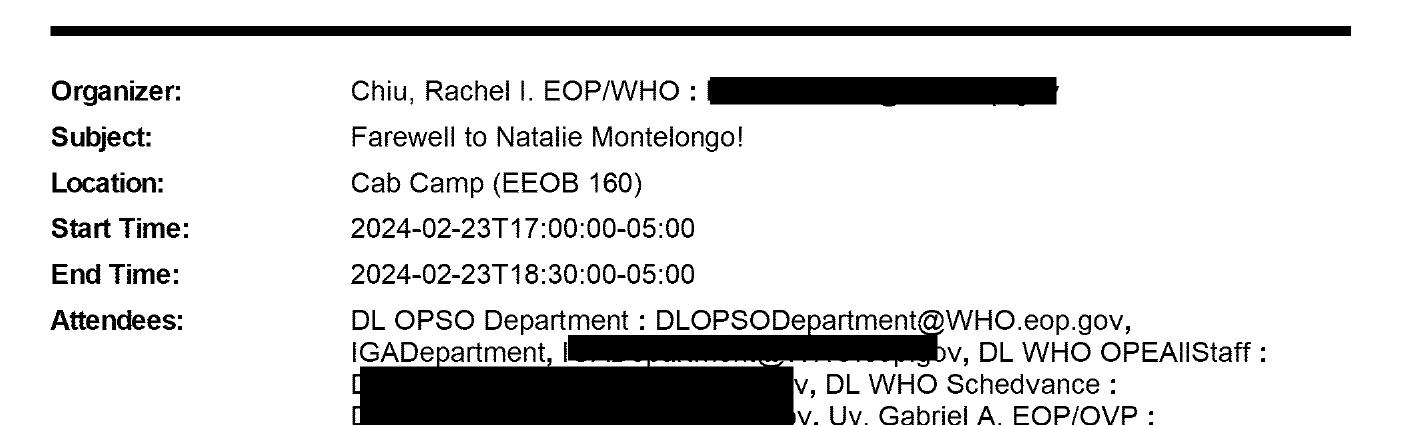
Its attendee list opens with four distribution lists: “DL OPSO Department,” “IGADepartment,” “DL WHO OPEAllStaff,” and “DL WHO Schedvance.” One address is printed in full: DLOPSODepartment@WHO.eop.gov. (record) The record does not spell out the lists’ abbreviations, but the root domain identifies them: who.eop.gov is the domain of the White House Office, part of the Executive Office of the President, which places these lists among the president’s core staff.

Transcription Email header, February 16, 2024 (PDF p. 1)
“From: Chiu, Rachel I. EOP/WHO … Sent: 2/16/2024 11:24:37 PM … To: Chiu, Rachel I. EOP/WHO; DL OPSO Department [withheld]; IGADepartment [withheld]; DL WHO OPEAllStaff [withheld]; DL WHO Schedvance [withheld]; …”

The same lists appear in the message header on the release’s first page, where the agency blacked out their addresses. (record) Addresses at the Office of the Vice President, the National Security Council, and the Office of Management and Budget were left visible in the header, while most White House Office addresses were blacked out. (record) Those redactions carry no exemption labels. (record) Exemption 6, the usual basis for withholding individual addresses, applies to files whose release “would constitute a clearly unwarranted invasion of personal privacy.” (statute)
A list address printed in a release becomes a search term for the next request. Such a request can name the custodians and the period and ask for “all emails and calendar invitations received by [custodians] between [start date] and [end date] that were addressed to the distribution list [list name or address],” along with records sufficient to show the name, address, and description of each list an office uses to reach its political appointees or Senior Executive Service members. The file as released contains no response letter.
Type 4: Intranet Pages and Screenshots
Intranet captures show an agency’s internal website: home pages, office landing pages, menus, site maps, and the portals for internal tools. FOIA’s definition of a record includes information “maintained by an agency in any format, including an electronic format.” (statute) The pages are kept by the office that runs the intranet, usually a chief information officer’s staff, and by each office that publishes on it.
What they offer is names: of internal systems, databases, document libraries, offices, and roles. Each name is a hook for a narrower follow-up request that cites the exact system or office, and together they map how an agency is organized from the inside. The same approach underlies a separate guide to SharePoint and browser-history requests.
The release comes from the Justice Department’s Justice Management Division, which “provides advice and counsel to senior management officials relating to all administrative functions of the Department.” (JMD) It runs 39 pages: screenshots of the division’s DOJNet pages, staff profiles from its public website, the cover of the “Justice Management Division Correspondence Style Guide,” and the “JMD Sitemap.” (record) The file as released contains no response letter. The division’s page on DOJNet, the department’s intranet, lists its staffs in a left-hand menu and links to an organizational chart, a document library, and internal tools. (record)

Transcription DOJNet, Justice Management Division landing page (PDF p. 1)
“DOJNet · U.S. Department of Justice Intranet … HOME · PEOPLE PLACES & OFFICES · YOUR CAREER · HEALTH & WELFARE · RESOURCES · POLICY, DIRECTIVES & GUIDANCE · INFORMATION TECHNOLOGY”
“Quick Links: DOJ Employee Service Portal (DOJEMP) · DOJ Libraries Acquisitions Services · Payroll Calendar · Flexible work options · JMD Supervisors’ Corner · DOJ Libraries Research Guides · JMD Correspondence Style Guide”
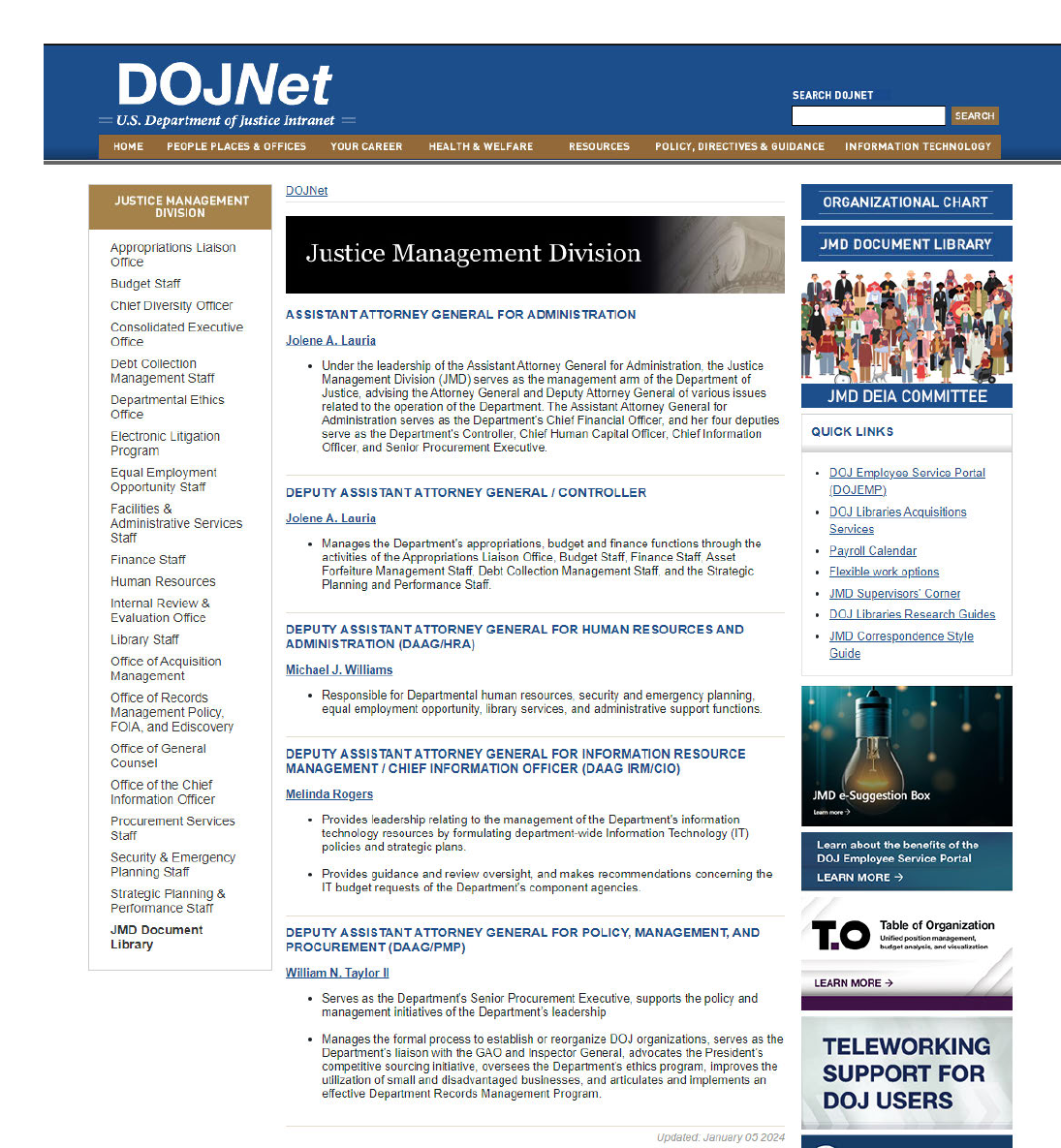
Thirteen of the systems and collections named in the screenshots are listed below with the pages where they appear.
| Name in the screenshots | Where or what, as shown | PDF pages |
|---|---|---|
| DOJ Employee Service Portal (DOJEMP) | Employee service requests and issue reports, per its overview | 1, 34 |
| Table of Organization (T.O.) | Position management system for approved positions, managed by HR and the Budget Staff | 1, 35, 39 |
| Justice Parking and Remote Credentialing (JPARC) | Electronic parking passes | 1, 37 |
| JSMART, Justice Security Management & Resource Tool | Security and Emergency Planning Staff SharePoint site, with menu items for an SPM Portal and a Ticketing System | 19 |
| webTA; Employment Fact Book; G-Invoicing | Entries in the Finance Staff menu under Financial Systems and Payroll | 30, 10 |
| JMD Ediscovery; Enterprise SharePoint; Justice Enterprise File Sharing (JEFS) System; JSTARS | Entries under Applications & Platform Services in the Chief Information Officer’s menu | 34 |
| OCIO Portal on SharePoint; Microsoft Teams; Office 365 | Telework resources page | 36 |
| JMD Document Library; JMD Fact Sheets | Internal document collections | 1, 21 |
| RIM Lexicon; RIM Directive; OneDrive File Plan Instructions | Records management office menu | 15 |
| Audit Liaison Handbook | Internal Review and Evaluation Office menu | 12 |
| Purchase Card Program; Procurement Information Bulletins (PIBs) | Procurement Services Staff menu | 18 |
| JMD Correspondence Style Guide | Cover page | 38 |
| JMD Sitemap | Four deputy portfolios and the staffs under each | 39 |
Names as printed in the screenshots, with spelling normalized where the image is legible. The list is not exhaustive. Internal addresses shown in the images are not reproduced as links.
A request for this kind of record can ask for captures as of a date, the site map or navigation menu, and records showing the names of listed systems, for example “screenshots or PDF captures of the [agency] intranet home page and of the landing pages of [office], as they appeared on [date], and a copy of the intranet site map or navigation menu for [office].”
Staff contact details draw Exemption 6. In this release, (b)(6) markings cover contact panels on several pages, for example pages 4, 9, 16, 34, and 35. (record) Exemption 2 applies to records “related solely to the internal personnel rules and practices of an agency,” a scope the Supreme Court read by its plain language in Milner v. Department of the Navy. (DOJ) Exemption 7(E) can reach law enforcement techniques, and the Justice Department’s guide cites rulings that allowed agencies to withhold certain database names and identifiers. (DOJ) Draft pages can draw Exemption 5. (statute)
The release ends with the division’s sitemap, which arranges its staffs under four deputy assistant attorneys general: chief information officer; controller; human resources and administration; and policy, management, and procurement. (record)

Transcription JMD Sitemap (PDF p. 39)
“JMD Sitemap · Justice Management Division (JMD) · DAAG Chief Information Officer · Office of the Chief Information Officer (OCIO) · Cybersecurity Services Staff (CSS) · Policy & Planning Staff (PPS) · Service Delivery Staff (SDS) · DAAG Controller …”
“Security & Emergency Planning Staff (SEPS) (SharePoint site) … Office of Records Management Policy, FOIA, and Ediscovery (ORMP) … Procurement Services Staff (PSS)”
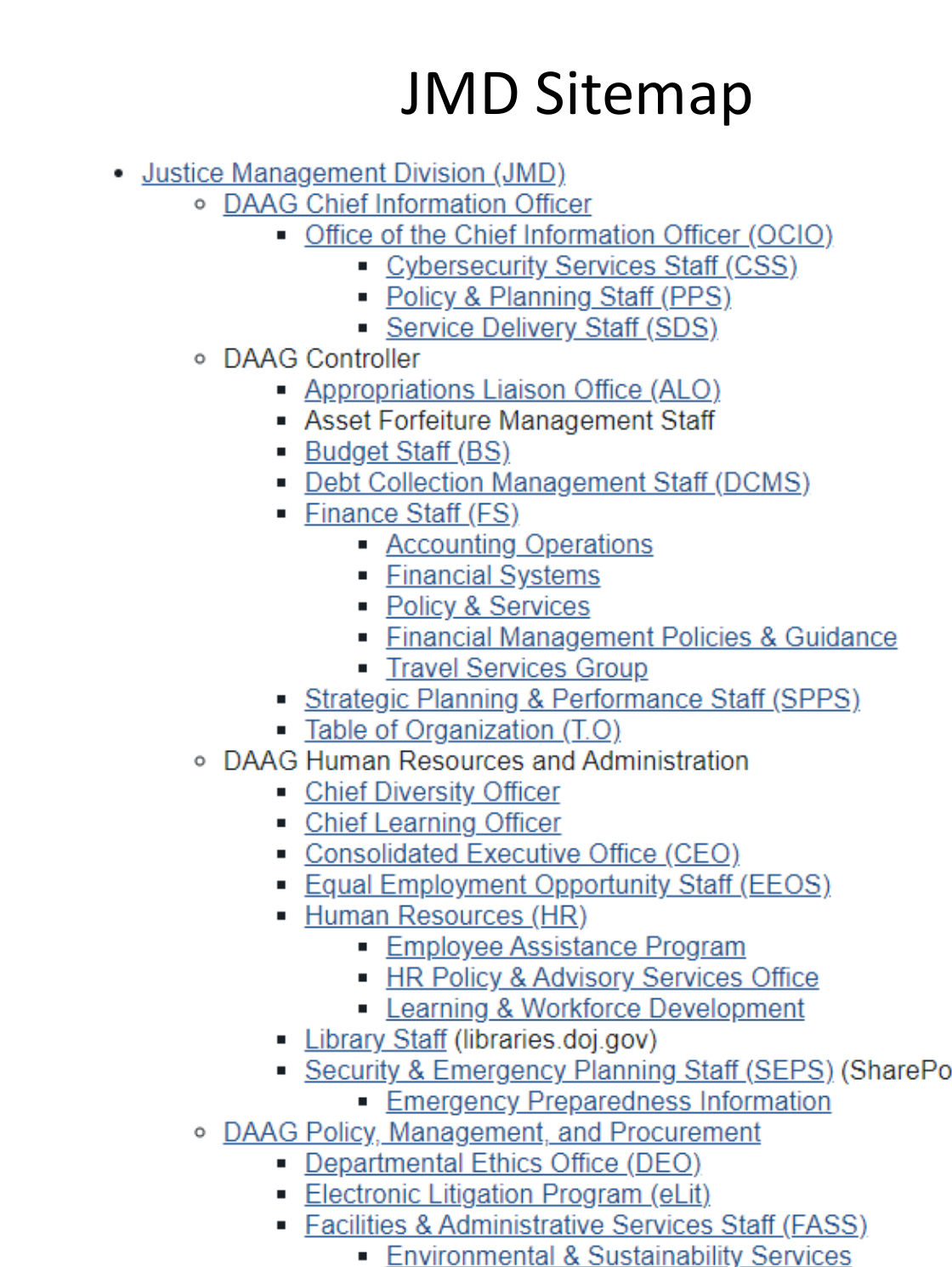
The sitemap page carries no redactions. (record)
