
What records can Congress, a federal agency or a court force a tech company to hand over about your account?
All three branches can compel records. A congressional or agency subpoena needs no judge, and served on a tech company it reaches basic subscriber records such as name, address, IP logs, device identifiers and payment data. Records of who communicated with whom, and when, need a judge’s § 2703(d) order. Message content needs a warrant based on probable cause.
Every branch of the federal government can make you hand over records. Congress does it with committee subpoenas. Executive agencies do it with administrative subpoenas that their own lawyers sign. Courts do it with grand jury subpoenas, court orders and search warrants. The three instruments look alike on paper. Each opens with a command and ends with a signature. But they rest on different constitutional footing, they answer to different standards, and they reach different things.
Two Freedom of Information Act releases show the difference in the government’s own paperwork. The first is a 53-page file of seven House committee subpoenas served on the FBI in 2023, four of them on then-Director Christopher A. Wray. The second is a 35-page Naval Criminal Investigative Service release of ten subpoenas from November 2025. Most went to Apple, Google, Meta, Snap and other providers for account records. Both are posted below in full, with page images of the key passages.
The documents
The House file collects seven subpoenas, issued “By Authority of the House of Representatives of the Congress of the United States of America,” with their schedules, instructions and cover letters. Six came from the Committee on the Judiciary and one from the Committee on Oversight and Accountability. Five demand documents from the FBI and three of its officials were ordered to sit for depositions. The schedules range from school-board threat investigations to an FBI Richmond field office analysis of “Radical-Traditionalist Catholics,” informant forms mentioning “Biden,” and the bureau’s contacts with social media companies on content moderation.
The NCIS release answers requests for “all subpoenas issued by this Service for the month of November 2025.” The agency’s letter, dated Feb. 18, 2026, says a search “resulted in locating ten subpoenas responsive to your request.” Eight are Defense Department inspector general subpoenas, one is a military judge’s subpoena to a hotel and one is a sealed federal court subpoena withheld in full. Names, email addresses, usernames and phone numbers of the people involved are blacked out under FOIA exemptions (b)(6) and (b)(7)(C).
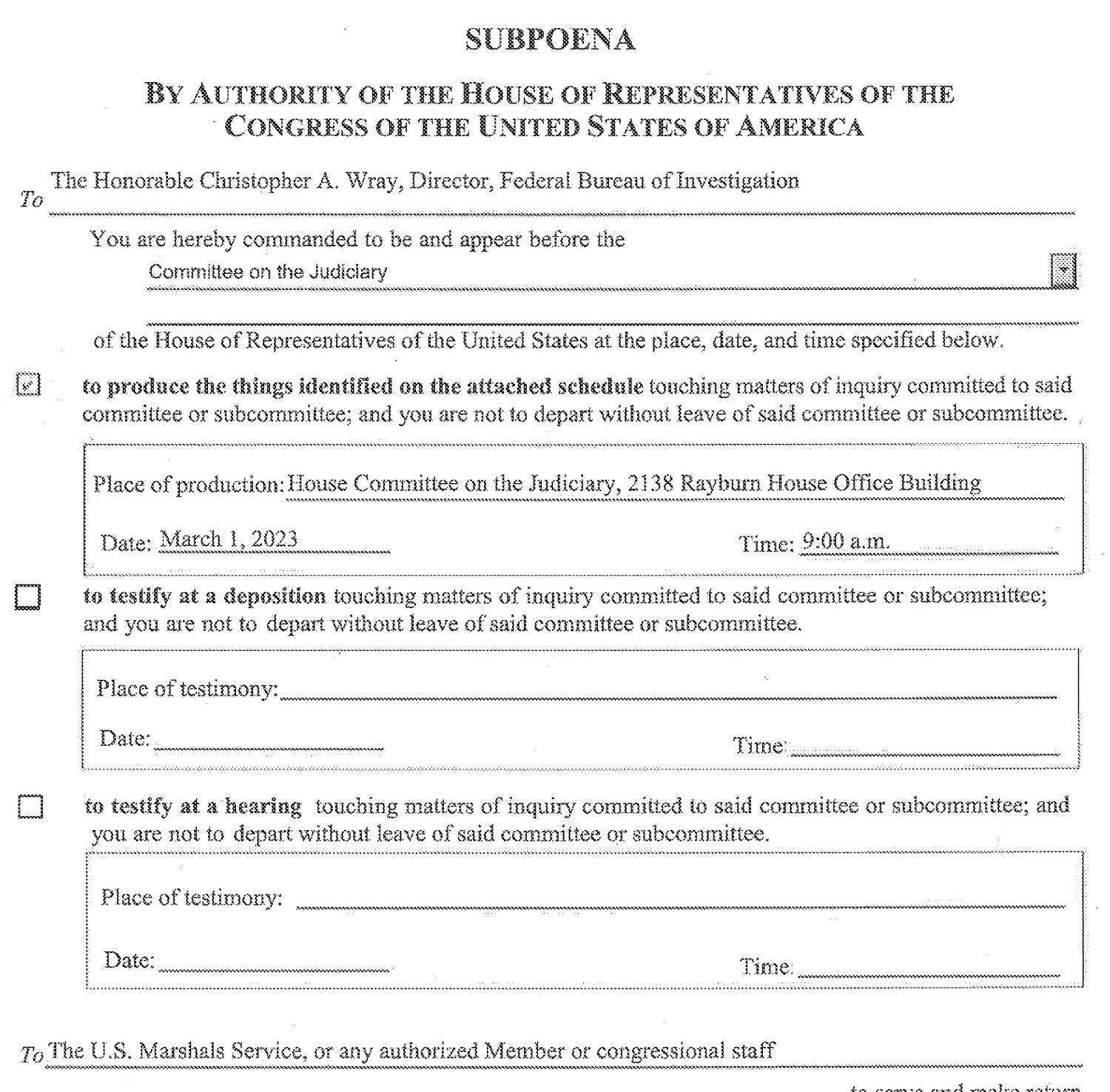
House Judiciary and Oversight Committee subpoenas to the FBI, 2023
Released under FOIA. The file carries no agency cover letter. Hosted as received, without a text layer.
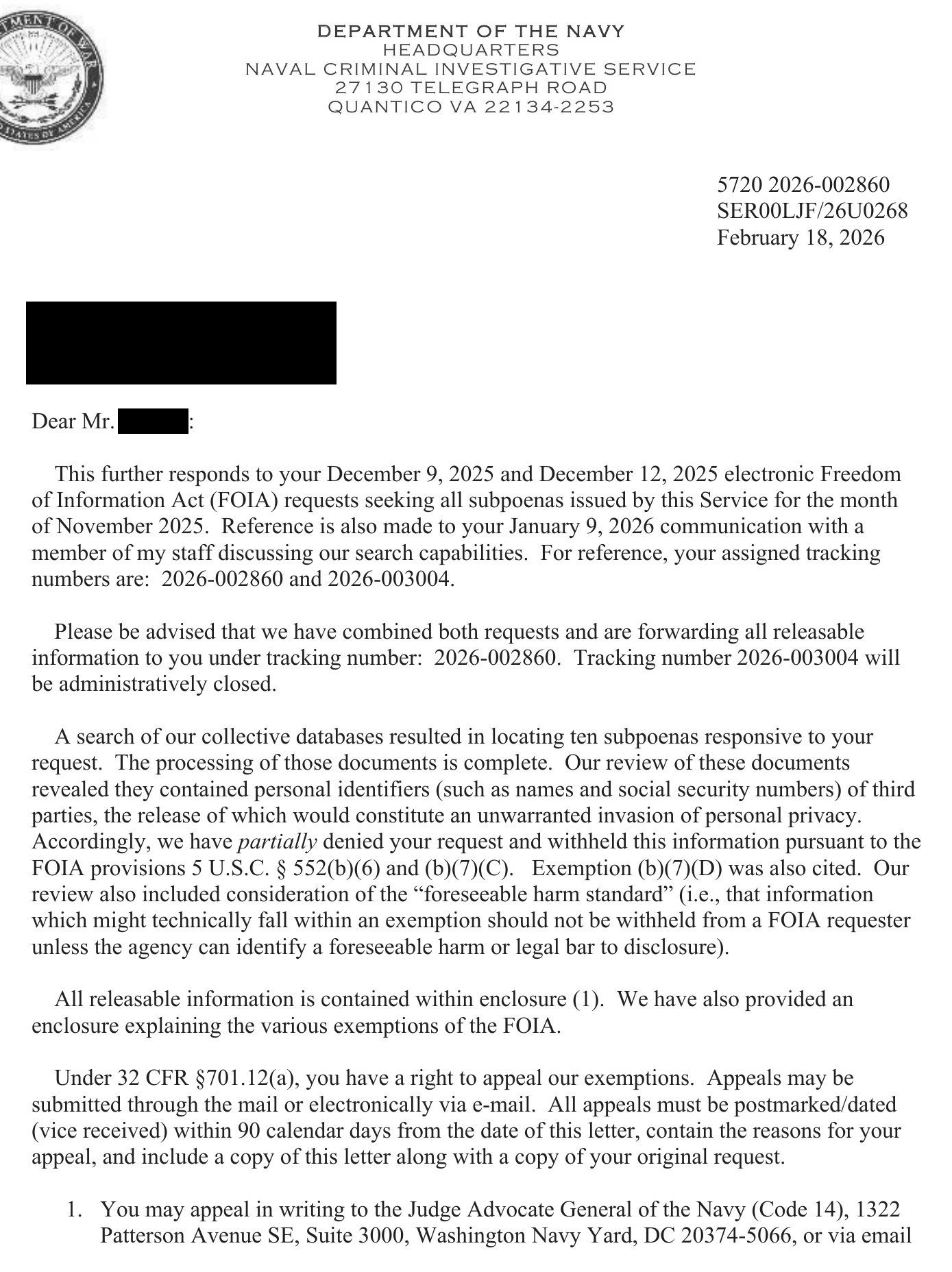
NCIS FOIA release 2026-002860: ten subpoenas, November 2025
Released by the Naval Criminal Investigative Service under FOIA. Redactions under (b)(6), (b)(7)(C) and (b)(7)(D) are the agency’s.
Editor’s note: The House file is a scanned image with no text layer; OctoProbe ran optical character recognition on every page to read it, and each quotation below was checked against the page image. The file contains no agency transmittal letter, so the releasing agency and requester cannot be confirmed from the document itself. Two proof-of-service pages appear out of order (page 2 is captioned for Thomas J. Sobocinski; page 53 for Wray). Both PDFs are hosted exactly as received. Page images were cropped and converted to grayscale; all redactions are the agencies’ own. Checksums are in the SHA256SUMS file.
Where does each branch get the power to compel?
Each branch draws on a different article of the Constitution. Congress’s subpoena power is implied from Article I’s grant of “legislative Powers.” Agencies have only the subpoena power a statute gives them. The courts issue process under Article III and the Federal Rules of Criminal Procedure, and only a judge can sign a search warrant.
| Branch | Instrument | Who issues | Legal standard | What it can reach | How enforced |
|---|---|---|---|---|---|
| Article I (Congress) | Committee subpoena | Committee chair or authorized member; attested by the clerk | Must serve a valid legislative purpose and cover “matters of inquiry committed to said committee”; no judge beforehand | Documents and testimony from officials, companies and private persons | Criminal contempt referral (2 U.S.C. §§ 192, 194) or a civil lawsuit |
| Article II (Executive) | Administrative subpoena, e.g. an inspector general subpoena duces tecum | Agency official under statute; here a DoD inspector general lawyer, at NCIS’s request | Within the agency’s authority, not too indefinite, reasonably relevant (United States v. Morton Salt Co.); no judge beforehand | Only what the statute allows. From a provider: the six basic subscriber categories in 18 U.S.C. § 2703(c)(2). IG subpoenas cannot compel testimony | Government asks a district court for an order; defying the order is contempt of court |
| Article III (Courts) | Grand jury or trial subpoena (Fed. R. Crim. P. 17) | Court clerk issues it signed and sealed; prosecutor fills it in | Relevance (United States v. R. Enterprises, Inc.) | Documents and testimony; from a provider, the same § 2703(c)(2) subscriber records | Contempt of court |
| Article III (Courts) | § 2703(d) court order | Judge | “Specific and articulable facts” showing the records are “relevant and material” to an ongoing criminal investigation | Metadata, the who-not-what: sender and recipient logs, email headers, call and text logs; no content | Contempt; provider may move to quash if unduly burdensome |
| Article III (Courts) | Search warrant (Fed. R. Crim. P. 41; § 2703(a)) | Neutral magistrate or judge, on oath | Probable cause and particularity | Stored content: email, messages, photos, cloud files; also anything lower tiers reach | Executed by agents; provider must comply |
Editor’s note: Military judges can also issue subpoenas and Stored Communications Act warrants in cases under the Uniform Code of Military Justice. That system, created by Congress under Article I and run inside the Defense Department, is discussed separately below.
Article I: What can a congressional subpoena demand?
A congressional subpoena can demand almost anything that bears on a committee’s jurisdiction, from anyone, and no judge reviews it before it goes out. The form itself sets the scope. Each subpoena in the House file opens with the same command: “You are hereby commanded to be and appear before the Committee on the Judiciary of the House of Representatives of the United States at the place, date, and time specified below.” A checkbox then selects what is required: “to produce the things identified on the attached schedule,” “to testify at a deposition” or “to testify at a hearing,” each “touching matters of inquiry committed to said committee or subcommittee; and you are not to depart without leave of said committee or subcommittee.”
The form is addressed to “The U.S. Marshals Service, or any authorized Member or congressional staff to serve and make return,” and closes: “Witness my hand and the seal of the House of Representatives of the United States, at the city of Washington, D.C.” It is signed by the “Chairman or Authorized Member” and attested by the clerk.

What a committee wants goes in the schedule. The first Wray subpoena, signed in February 2023, demanded records “from January 26, 2021 to present, in unredacted form” about the attorney general’s Oct. 4, 2021, memorandum on threats to school officials and the FBI’s “EDUOFFICIALS threat tag.”

The instructions widen the net. The subpoenas define “documents in your possession, custody or control” to include “documents that have been placed in the possession, custody, or control of any third party.” The definition of “communication” runs from email and text to “encrypted instant messaging application (e.g., Signal, WhatsApp, Telegram, etc.),” Discord, Microsoft Teams, Slack and “one-way communications channels (e.g., Teleporter).”

The House also tells recipients which objections it will ignore. Under Instruction 17, “the Committee does not recognize: any purported non-disclosure privileges associated with the common law including; any purported privileges or protections from disclosure under the Freedom of Information Act; or any purported contractual privileges, such as non-disclosure agreements.” Any such “non-constitutional legal bases for withholding” are declared “of no legal force and effect” unless the committee agrees otherwise. Constitutional claims, such as executive privilege or the Fifth Amendment, are not on the list.

Testimony subpoenas use the same form with a different box checked. Two Judiciary subpoenas dated Aug. 21, 2023, ordered FBI Baltimore field office officials Thomas J. Sobocinski and Ryeshia Holley to sit for depositions in September about the Justice Department’s investigation of Hunter Biden.

What limits a congressional subpoena?
The limit is purpose. The Constitution never mentions congressional subpoenas, and the Supreme Court has read the power as implied. In McGrain v. Daugherty (1927), the Court held “that the power of inquiry—with process to enforce it—is an essential and appropriate auxiliary to the legislative function.” Thirty years later, in Watkins v. United States (1957), it added: “There is no general authority to expose the private affairs of individuals without justification in terms of the functions of the Congress.”
The modern statement is Trump v. Mazars USA, LLP (2020). “Congress has no enumerated constitutional power to conduct investigations or issue subpoenas,” Chief Justice John Roberts wrote, “but we have held that each House has power ‘to secure needed information’ in order to legislate.” A subpoena is valid only if it is “related to, and in furtherance of, a legitimate task of the Congress,” and Congress “may not issue a subpoena for the purpose of ‘law enforcement,’ because ‘those powers are assigned under our Constitution to the Executive and the Judiciary.’”
The committees’ cover letters are written with that test in mind. The Judiciary Committee’s April 10, 2023, letter to Wray, sent with a subpoena for the Richmond field office’s “Radical-Traditionalist Catholic” analysis, quotes the Court’s description of oversight as “broad and indispensable,” cites Mazars in a footnote and lists possible bills: “legislation to prescribe how federal law-enforcement entities investigate constitutionally protected activity.” It says the subpoena was issued “in light of your disregard of our earlier voluntary requests.”


The Oversight Committee’s May 3, 2023, letter claims “broad authority to investigate ‘any matter’ at ‘any time’ under House Rule X” and says the subpoena “is issued pursuant to my authority as the Chairman of the Committee pursuant to both Rule XI.2(m)(1)(B) of the Rules of the House of Representatives and Rule 12(g) of the Committee’s rules.” Its schedule has one line: “All FD-1023 forms, including within any open, closed, or restricted access case files, created or modified in June 2020, containing the term ‘Biden.’”


The Judiciary Committee’s Aug. 17, 2023, subpoena reached the FBI’s dealings with tech platforms. It demanded, from Jan. 1, 2020, “All documents and communications referring or relating to the moderation, deletion, suppression, restriction, or reduced circulation of content,” and all records on “alleged ‘misinformation,’ ‘disinformation,’ or ‘malinformation.’” The cover letter said the FBI’s “response without compulsory process has, to date, been woefully inadequate.”

How does Congress enforce a subpoena?
In practice, Congress relies on the other two branches to enforce its subpoenas. The criminal route is a contempt referral. Under 2 U.S.C. § 192, a summoned witness who “willfully makes default” is guilty of a misdemeanor, punishable by a fine of $100 to $1,000 and one to 12 months in jail. Under § 194, the speaker certifies the failure to the U.S. attorney, “whose duty it shall be to bring the matter before the grand jury for its action.” That puts an executive-branch prosecutor in charge of enforcing a subpoena that is often aimed at the executive branch.
The civil route is a lawsuit. In Committee on the Judiciary v. McGahn, the full D.C. Circuit held in August 2020 “that the Committee has Article III standing to seek enforcement in federal court of its duly issued subpoena in the performance of constitutional responsibilities.” That did not end the case. A panel later ruled the committee had no cause of action; the full court agreed to rehear that question, and the dispute was settled in 2021, when former White House counsel Donald McGahn sat for a closed-door transcribed interview. The litigation took nearly two years.
Can Congress subpoena your email?
The House subpoenas in this file went to the FBI for the FBI’s records. Whether a committee can compel Google or Meta to produce a private user’s account data is a harder question, and the Stored Communications Act does not answer it cleanly. The law’s compelled-disclosure section, 18 U.S.C. § 2703, is written for a “governmental entity,” which § 2711 defines as “a department or agency of the United States or any State or political subdivision thereof.” A House committee is neither.
Section 2702 bars public providers from knowingly divulging stored content “to any person or entity,” and none of its exceptions covers a congressional subpoena. For non-content records, the same section lets a provider disclose customer information “to any person other than a governmental entity.” The Supreme Court has not decided how those provisions fit with Congress’s implied subpoena power.
| # | Signed | Committee | Recipient | Ordered to | Return date | Schedule | Pages |
|---|---|---|---|---|---|---|---|
| 1 | February 2023 | Judiciary | Christopher A. Wray, FBI director | Produce documents | March 1, 2023 | School-board threat memo, DOJ task force, “EDUOFFICIALS” threat tag; Jan. 26, 2021, to present | 1–10 |
| 2 | April 10, 2023 | Judiciary | Wray | Produce documents | April 28, 2023 | Richmond field office “Radical-Traditionalist Catholic” analysis, 7 items | 11–22 |
| 3 | April 24, 2023 | Judiciary | Jennifer Leigh Moore, executive assistant director, Human Resources Branch | Deposition | May 10, 2023 | None | 23–24 |
| 4 | May 3, 2023 | Oversight and Accountability | Wray | Produce documents | May 10, 2023 | FD-1023 forms from June 2020 containing “Biden” | 25–28 |
| 5 | Aug. 17, 2023 | Judiciary | Wray | Produce documents | Sept. 18, 2023 | Content moderation; “misinformation,” “disinformation,” “malinformation”; Jan. 1, 2020, to present | 29–41 |
| 6 | Aug. 21, 2023 | Judiciary | Ryeshia Holley, assistant special agent in charge, Baltimore | Deposition | Sept. 11, 2023 | None (cover letter: Hunter Biden investigation) | 42–47 |
| 7 | Aug. 21, 2023 | Judiciary | Thomas J. Sobocinski, special agent in charge, Baltimore | Deposition | Sept. 7, 2023 | None (cover letter: Hunter Biden investigation) | 48–53 |
Editor’s note: Dates are from the handwritten signature lines; the day on the first subpoena is hard to read, so only the month is given. Page numbers refer to the hosted PDF.
Article II: What can an inspector general’s subpoena reach?
An agency subpoena reaches only what the statute behind it authorizes, and for accounts held by a tech company, that is subscriber metadata, not content. The NCIS release shows how the process works in practice.

| # | Recipient | Identifier targeted | Stated basis | Period | Returnable to | ID / pages |
|---|---|---|---|---|---|---|
| 1 | Apple Inc. | Email address | “an unknown individual involved in an extortion scheme against a dependent child of a member of the United States Armed Forces” | Oct. 5, 2025, to date of subpoena | NCIS Resident Agency Naples, Italy | 20260120-44836, pp. 6–7 |
| 2 | Google LLC | Email address | Same extortion scheme | Oct. 5, 2025, to date of subpoena | NCIS Naples | 20260120-44828, pp. 8–9 |
| 3 | Meta Platforms | Facebook username and user ID | “the illegal sale of stolen Department of Defense property” | March 1, 2024, to Sept. 1, 2025 | NCIS Washington, D.C., field office | 20251522-44541, pp. 10–11, 13–18 |
| 4 | Hilton San Diego Bayfront | Guest named in Attachment A (Navy member, name redacted) | Military justice subpoena, DD Form 453, issued by a military judge | Stays and charges Feb. 9–12, 2025; surveillance video | Military justice case | pp. 19–20 |
| 5 | Snap Inc. | Phone number and Snapchat username | “an unknown individual(s), who is suspected of violating one or more criminal statutes and/or punitive Articles of the Uniform Code of Military Justice” | July 1 to Sept. 30, 2025 | NCIS Resident Agency Miramar, San Diego | 20260061-44701, p. 21 |
| 6 | T-Mobile | Phone number | Same as No. 5 | July 1 to Sept. 30, 2025 | NCIS Miramar | 20260061-44702, p. 22 |
| 7 | Withheld in full | Not disclosed | “Sealed Subpoena: Originated with the U. S. District Court, Southern District of California” | Not disclosed | Not disclosed | p. 23 (original pp. 18–20) |
| 8 | Snap Inc. | Two Snapchat usernames | “a witness of a crime and member of the United States Armed Forces, who is suspected of violating” criminal statutes or the UCMJ | May 24, 2025, to date of subpoena | NCIS Far East Field Office, Yokosuka, Japan | 20251506-44508, pp. 24–27 |
| 9 | Google LLC | Email address | “a member of the United States Armed Forces, who is suspected of violating” criminal statutes or the UCMJ | May 24, 2025, to date of subpoena | NCIS Yokosuka | 20251506-44507, pp. 28–31 |
| 10 | Mediatti Broadband Communications | IP address | Same as No. 9 | 21:30:16 UTC May 24 to 11:18:01 UTC May 27, 2025 | NCIS Yokosuka | 20251506-44509, pp. 32–35 |
Editor’s note: The release also contains one page that is not a subpoena: Attachment A to a search warrant for a Kik account (p. 12), discussed below. The Snap and T-Mobile subpoenas from Miramar (Nos. 5 and 6) were released without appendices. The hotel subpoena is dated Oct. 17, 2025; the others carry no issue date, and the unique identification numbers are the inspector general’s.
Who signs it?
No judge. NCIS has no subpoena power of its own in these cases; it borrows the Defense Department inspector general’s. Each subpoena commands the custodian “TO APPEAR BEFORE Special Agent [redacted] or any Special Agent of the Naval Criminal Investigative Service (NCIS) acting on behalf of the Inspector General, pursuant to the Inspector General Act of 1978 (5 U.S.C. § 406(a)(4)).” Each is signed “IN TESTIMONY WHEREOF” by an “Associate General Counsel, Office of General Counsel” whose name is redacted, “at Alexandria, Virginia.”

The statute, 5 U.S.C. § 406(a)(4), lets an inspector general “require by subpoena the production of all information, documents, reports, answers, records, accounts, papers, and other data in any medium (including electronically stored information)” that is “necessary in the performance of the functions assigned by this chapter.” The subpoenas track that language almost word for word, demanding “information, documents, reports, answers, records, accounts, papers, and other data” that “are necessary in the performance of the responsibility of the Inspector General under the Inspector General Act.”
The Pentagon watchdog’s own subpoena program page spells out the limits. Any agent of NCIS, Army CID, Air Force OSI or the Defense Criminal Investigative Service may request one. “IG subpoenas cannot compel testimony.” And “A DoD OIG subpoena may only be used for records that have some DoD nexus.” The same page suggests that for records needed in two days, “your situation seems to call for a search warrant rather than a subpoena, provided you have probable cause.”
The courts give agencies wide room. In United States v. Morton Salt Co. (1950), the Supreme Court said an agency “can investigate merely on suspicion that the law is being violated, or even just because it wants assurance that it is not,” and that a demand is enforceable “if the inquiry is within the authority of the agency, the demand is not too indefinite and the information sought is reasonably relevant.”
How is it enforced?
Through a court, after the fact. The Privacy Act notice served with each subpoena says “Disclosure of information is mandatory,” then explains: “Failure to comply with a subpoena may result in the Inspector General’s requesting a court order for compliance. If such an order is obtained and you thereafter fail to supply the information, you may be subject to civil and/or criminal sanctions for contempt of court.” That matches the statute, which makes the subpoena “enforceable by order of any appropriate United States district court.”

The custodian letters add a request, not an order: “This investigation is private and we request such privacy be maintained.” A provider can be legally barred from telling its customer only by a court. Under 18 U.S.C. § 2705(b), the government “may apply to a court” for a nondisclosure order, which the court grants if notice would endanger someone, prompt flight, destruction of evidence or witness intimidation, or otherwise seriously jeopardize an investigation. The letters also tell recipients they have “the right to consult with and have an attorney represent you in this matter.”

The scope limit: basic subscriber information
The key limit on a subpoena served on a tech company is in 18 U.S.C. § 2703(c)(2). When the government “uses an administrative subpoena authorized by a Federal or State statute or a Federal or State grand jury or trial subpoena,” a provider must disclose six things about a subscriber:
- “name”;
- “address”;
- “local and long distance telephone connection records, or records of session times and durations”;
- “length of service (including start date) and types of service utilized”;
- “telephone or instrument number or other subscriber number or identity, including any temporarily assigned network address”; and
- “means and source of payment for such service (including any credit card or bank account number).”
The next paragraph adds that a government agency receiving those records “is not required to provide notice to a subscriber or customer.” Anything beyond the six categories, other than content, takes a court order or warrant under § 2703(c)(1). Content is governed by § 2703(a) and (b).
Every NCIS subpoena to a provider says it seeks only that tier. Each Appendix A begins: “This subpoena calls for the production of records setting forth the basic subscriber information identified below, authorized by the Stored Communications Act (18 U.S.C. § 2701, et seq.).”
Apple, Google, Meta and Snap, item by item
The four companies got four different lists. Each tracks the statute’s categories closely, and each mirrors the company’s own published guidance for police.

Apple’s appendix asks for seven things, including “iCloud subscriber information and connection logs with IP addresses,” “Media Access Control (MAC) addresses and unique device identifier (UDID),” “iOS device activation information, including but not limited to the IP addresses of the event and ICCID numbers,” and “Sign-on Logs for Apple services such as iTunes, iCloud, My Apple ID, and Apple discussions.” Apple’s legal process guidelines say “iCloud customer information and connection logs with IP addresses, if available, may be obtained with a subpoena or greater legal process,” and that connection logs “are retained up to 25 days.”

Google’s appendix is the statute itself, expanded with examples. It asks for “Records of session times and durations, and the temporarily assigned network addresses (such as Internet Protocol (‘IP’) addresses) associated with those sessions,” device identifiers from MAC addresses to IMSI and IMEI numbers, and “Means and source of payment for such service (including any credit card or bank account number) and billing records.” The broadband subpoena to Mediatti uses the same eight-item list.


Meta’s is the shortest: “Name”; “Length of service”; “Credit card information”; “Email address(es) and phone number(s)”; and “Login/logout IP address(es) and associated timestamps.” Meta’s law enforcement guidelines say a subpoena compels “basic subscriber records (defined in 18 U.S.C. Section 2703(c)(2)), which may include: name, length of service, credit card information, email address(es), and a recent login/logout IP address(es), if available.”

Snap’s list was lifted from Snap’s law enforcement guide, which says “Basic subscriber information consists of the categories of information listed at 18 U.S.C. § 2703(c)(2), which for Snap may include” the same seven items, from “Current and previous Snapchat usernames” to “Snapchat account creation date and IP address.”
| Requested item | Apple | Google / Mediatti | Meta | Snap | § 2703(c)(2) category |
|---|---|---|---|---|---|
| Name, username, display name | Yes | Yes | Yes | Yes | (A) name |
| Postal or email address | Yes | Yes | Yes | Yes | (B) address; (E) identity |
| Phone number | Yes | Yes | Yes | Yes | (E) subscriber number |
| Session or login times with IP addresses | Yes (connection, sign-on logs) | Yes | Yes | Yes | (C) session records; (E) network address |
| Account start date, services used | No | Yes | Yes (length of service) | Yes (creation date) | (D) length and type of service |
| Device identifiers (MAC, UDID, ICCID, IMEI, IMSI) | Yes | Yes | No | No | (E) instrument number |
| Payment details | No | Yes | Yes (credit card) | No | (F) means and source of payment |
| Customer service records | Yes | No | No | No | Not listed |
| “Certain information about the user’s use of Snapchat services and account settings” | No | No | No | Yes | Not clearly listed |
| Messages, photos, contacts, location history, other content | No | No | No | No | Not available by subpoena |
Editor’s note: Two items fall outside the six statutory categories on their face: Apple’s “Customer Service Records” and Snap’s “Certain information about the user’s use of Snapchat services and account settings.” Neither is message content, and both companies’ published guides list them as available with a subpoena. Which records a provider actually returned is not in the release.
Nothing in any appendix asks for an email, a message, a photo, a contact list or stored location history. That is not restraint. A subpoena can’t get them.
Following an IP address
The three Yokosuka subpoenas show how subscriber records chain together. They carry consecutive identification numbers, 20251506-44507 through -44509, start on the same date, May 24, 2025, and concern a service member under investigation. Snap was asked for two usernames’ records, including “IP addresses (and timestamps) relating to various Snapchat account actions.” Google was asked for an email account’s session logs and IP addresses. Mediatti, a broadband company with a military post office address, was asked who was assigned one IP address during a window of about 62 hours.

That is the usual sequence. A platform subpoena returns IP addresses and timestamps. A second subpoena to the internet provider that owns the address returns the name and billing address of the customer it was assigned to. Neither step needs a judge. The Apple and Google subpoenas from Naples follow the same pattern: same case description, same Oct. 5, 2025, start date, two providers.

Why subscriber records get so little protection
The answer is the third-party doctrine. In United States v. Miller (1976), the Supreme Court held that “the Fourth Amendment does not prohibit the obtaining of information revealed to a third party and conveyed by him to Government authorities, even if the information is revealed on the assumption that it will be used only for a limited purpose and the confidence placed in the third party will not be betrayed.” Three years later, in Smith v. Maryland, it held that “a person has no legitimate expectation of privacy in information he voluntarily turns over to third parties.” A name, a billing address and a login IP handed to Google fit that description.
Carpenter v. United States (2018) drew a line for cell-site location records: “We decline to extend Smith and Miller to cover these novel circumstances.” But the Court kept the ordinary rule for everything else: “The Government will be able to use subpoenas to acquire records in the overwhelming majority of investigations. We hold only that a warrant is required in the rare case where the suspect has a legitimate privacy interest in records held by a third party.” For how investigators actually pull cell-site records from carriers after the ruling, and the gaps it left open, OctoProbe News walked through the FBI’s own field guide.
Article III: What does it take to get content?
A judge. Courts sit at the top of the ladder because only they can issue the instruments that reach stored content, and they also issue the grand jury subpoenas that prosecutors use for subscriber records.
Grand jury subpoenas
A grand jury subpoena is judicial process in name and prosecutorial in practice. Under Federal Rule of Criminal Procedure 17(a), “The clerk must issue a blank subpoena—signed and sealed—to the party requesting it.” The prosecutor fills in the rest. Its standard is relevance, and a loose one: in United States v. R. Enterprises, Inc. (1991), the Court held that a challenge on relevance grounds “must be denied unless the district court determines that there is no reasonable possibility that the category of materials the Government seeks will produce information relevant to the general subject of the grand jury’s investigation.” Served on a provider, it reaches the same § 2703(c)(2) subscriber records as an administrative subpoena.
The NCIS release contains one court-originated subpoena, and it is the only one withheld in full. The agency cited exemption (b)(7)(D), which protects confidential sources, for “Pages (18) - (20), Sealed Subpoena: Originated with the U. S. District Court, Southern District of California.” Its letter says that because the document originated with the court, “You must contact them directly for copies of their information.”

Section 2703(d) orders
A § 2703(d) order works like a pen register: it shows who was communicating with whom, when, for how long and through which cell tower, but not what anyone said. That is the metadata: who, not what. To read the message or hear the call, the government still needs a warrant.
It is the middle rung, and a judge has to sign it. The bar sits above a subpoena’s and below a warrant’s: under § 2703(d), the government must offer “specific and articulable facts” that the records are “relevant and material to an ongoing criminal investigation.” Probable cause is not required.
The companies describe what that buys. Apple’s guidelines say iCloud “Mail logs include records of incoming and outgoing communications such as time, date, sender email addresses, and recipient email addresses” and are available with “a court order under 18 U.S.C. §2703(d).” Meta’s guidelines say a (d) order reaches “message headers and IP addresses.” For phone carriers, the FBI’s 2019 field guide advises: “Court order 2703(d) or search warrant for historical call detail and cell site.” The guide’s legal-process tables show which records it puts under subpoena and which under an order or warrant. Since Carpenter, historical cell-site location records generally take a warrant, so that part of the phone data has moved up a rung.
The pen-register comparison is close to literal. A pen register logs the numbers a phone dials, and a trap-and-trace device logs the numbers that call it; both capture dialing and routing information as it happens, under a separate law, 18 U.S.C. § 3123. A § 2703(d) order reaches the same kind of who-not-what information after the fact, from records the provider has already stored. When investigators want both, live and stored, prosecutors often ask a judge for a hybrid order that combines the two.
Search warrants
The top rung is the warrant. The Fourth Amendment provides that “no Warrants shall issue, but upon probable cause, supported by Oath or affirmation, and particularly describing the place to be searched, and the persons or things to be seized,” according to the National Archives transcript. Rule 41(d)(1) puts it in procedural terms: a magistrate judge “must issue the warrant if there is probable cause to search for and seize a person or property or to install and use a tracking device.” Under § 2703(a), the government may compel email or messages stored for 180 days or less “only pursuant to a warrant.”
The statute’s text still allows more. For content older than 180 days or held in remote storage, § 2703(b) lets the government use “an administrative subpoena authorized by a Federal or State statute or a Federal or State grand jury or trial subpoena” if it gives the customer prior notice, which can be delayed. Courts and companies have largely closed that door. In United States v. Warshak (2010), the Sixth Circuit held: “The government may not compel a commercial ISP to turn over the contents of a subscriber’s emails without first obtaining a warrant based on probable cause.”
The providers say the same. Apple: “Apple will only provide content in response to a search warrant issued upon a showing of probable cause, or customer consent.” Meta: a warrant “is required to compel the disclosure of the stored contents of any account, which may include messages, photos, videos, timeline posts, and location information.” Google’s policy on government requests says U.S. authorities must “Get a search warrant to compel disclosure of the content of communications, such as email messages, documents, and photos.”
The NCIS release includes one warrant page, apparently misfiled between the Meta cover letter and subpoena. It is Attachment A, “Property to be Searched,” for a Kik account: “This warrant applies to records and information stored at premises owned, maintained, controlled, or operated by Kik C/O MediaLab.ai, located at 1222 6th Street, Santa Monica, CA 90401, and related to the identified user account listed below.” The footer reads “Attachment A AS ISSUED for Kik Warrant,” digitally signed Oct. 15, 2025. The issuing court is not shown.

The ladder
In plain terms: a subpoena tells investigators whose account it is, a § 2703(d) order tells them whom that account talked to and when, and a warrant lets them read what was said.
| Rung | Instrument | Standard | Signed by | What it unlocks from a provider |
|---|---|---|---|---|
| 1 | Administrative, grand jury or trial subpoena | Relevance | Agency official, committee chair or court clerk (blank) | Who owns the account: basic subscriber records, § 2703(c)(2)’s six categories |
| 2 | § 2703(d) court order | “Specific and articulable facts” that records are “relevant and material” | Judge | Who talked to whom, and when: email and message logs, call and text records, plus everything on rung 1 |
| 3 | Search warrant | Probable cause, on oath, describing the place and things | Judge or magistrate | What was said: stored messages, email, photos, cloud files, plus everything below |
Where does a military judge fit?
Between the branches. The hotel subpoena in the NCIS release is a DD Form 453, “Subpoena Military Justice Proceeding,” that commands Hilton San Diego Bayfront, “PURSUANT TO 10 U.S.C. §§ 846-47,” to produce the items in an attachment. It was “Issued by” a redacted name on Oct. 17, 2025, “as Military Judge.” The attachment seeks reservation details and room charges for Feb. 9–12, 2025, and “video surveillance within and outside of the Hilton San Diego Bayfront, including the floor” where the guest’s room was located.


Military judges are officers inside the Defense Department, but the court system they serve was created by Congress under its Article I power to make rules for the armed forces. The military’s top court, by statute, “is established under article I of the Constitution,” according to 10 U.S.C. § 941. Under 10 U.S.C. § 846, a military judge may issue an investigative subpoena before charges are referred and “may issue warrants or court orders for the contents of, and records concerning, wire or electronic communications in the same manner as such warrants and orders may be issued by a district court.” The Stored Communications Act recognizes those warrants by name in § 2703(a).
The form also carries its own penalty: “Failure to appear and testify or to produce items as directed above is punishable by a fine of not more than $1,000 or confinement for a period of not more than 30 days, or both, by the military judge (10 U.S.C. § 848).”
How long does the data even exist?
The law decides which records the government may demand. The phone company decides which records still exist, and its clock usually runs out first. In CAST’s provider-retention reference, the FBI’s own carrier chart, current as of March 2019, the content of a text message was the shortest-lived record listed: most carriers kept none, Verizon kept it for “7 days” and U.S. Cellular for “3-5 days.” Most federal crimes can be charged for five years.
Three clocks run at once on any request for phone records:
- The statute of limitations. It sets how long the government has to bring charges, and so how far back investigators will want to look. The default federal rule, 18 U.S.C. § 3282(a), is five years: “no person shall be prosecuted, tried, or punished for any offense, not capital, unless the indictment is found or the information is instituted within five years next after such offense shall have been committed.” Some clocks run longer. Bank fraud and other listed financial-institution crimes carry 10 years. For a capital offense, an indictment “may be found at any time without limitation,” under § 3281, and § 3299 removes the limit for listed child-abduction and sex offenses.
- The legal process. Which instrument reaches which record is the ladder above. A subpoena reaches basic subscriber records, including “local and long distance telephone connection records,” which for a phone company means call detail records. A § 2703(d) order reaches the metadata beyond that, who contacted whom and when, but not what was said. Historical cell-site location records generally take a warrant after Carpenter, which held that “the Government must generally obtain a warrant supported by probable cause before acquiring such records.” OctoProbe News has covered what Carpenter changed for cell-site requests. Stored content takes a warrant.
- Provider retention. It sets how long the carrier keeps each kind of record before deleting it. No subpoena, order or warrant can compel a record the provider no longer has.
The retention figures come from the Cellular Analysis & Geo-Location Field Resource Guide, a 139-page training and reference deck from the FBI’s Cellular Analysis Survey Team, or CAST, marked “Current as of March 2019.” It was released under FOIA to the transparency group Property of the People, and OctoProbe News hosts the full guide with its report on the guide. Its master chart, “Provider Retention Periods (As of March 2019),” covers seven carriers. Carrier pages later in the deck add detail.
Call detail records, the logs of which numbers called which and when, lasted from one year to seven. The master chart lists AT&T at “7 years,” Sprint at “18 months; backup tapes available 2005 to present,” T-Mobile at “2 years prepaid; since account opened with postpaid,” and Verizon and U.S. Cellular at “1 year.” Verizon’s own page puts “Call Details (with or without cell sites)” at “365 Rolling Calendar Days”; U.S. Cellular’s says “1 rolling calendar year.” Cell-site records, which place a phone near a tower sector, follow the same pattern for voice calls: AT&T “7 years,” T-Mobile “2 years,” Sprint “18 months,” Verizon and U.S. Cellular “1 year.”

Message content is another matter. On the master chart, AT&T’s entry for “SMS content” reads “No (AT&T msg app 90 days; ~10%).” Cricket, T-Mobile and MetroPCS read “No.” Sprint’s reads “Only on T-III,” shorthand for a Title III wiretap order, which intercepts messages as they are sent rather than retrieving stored ones. Verizon’s master entry is “7 days,” but Verizon’s own page in the same deck is shorter: “Text Message Content,” “3-5 Days (never more than 10 days),” at a cost of “$50 per 5 day increment.” It is the only row on that page with a price; every other row reads “N/A.” U.S. Cellular lists “Content of Text Messages” at “3-5 days.”

The records about those messages last far longer than the messages. Verizon kept “Text Message Details” for “365 Rolling Calendar Days” and U.S. Cellular kept “Text Message Records” for “1 rolling calendar year.” An investigator a year out may be able to prove two phones traded texts, but not what they said.

Much of the rest is measured in weeks. Store surveillance video ran “15-45 days (sbp)” at T-Mobile and MetroPCS, “30 days (sbp)” at Verizon, “30-60 days (sbp)” at U.S. Cellular and “2-3 months (sbp)” at Sprint. Voicemail was “14 days” at T-Mobile and MetroPCS and “20 days” at Sprint, and Verizon and U.S. Cellular listed “No.” Internet and web browsing records were “1 year” at AT&T and Cricket and “187 days” at Verizon, and T-Mobile, MetroPCS, Sprint and U.S. Cellular listed “No.” Verizon’s own page lists “IP Destination Information” at “60 Days.”
Set side by side, the clocks show that retention, not the law, is often the real limit. A fraud that surfaces 18 months after the fact is well inside the five-year limitations period, and a subpoena could reach the suspect’s call detail records. At Verizon or U.S. Cellular in 2019, those records would already have aged out of a one-year window. Text-message content was gone within days at the carriers that kept it at all, and most kept none. A warrant, the highest rung of the ladder, cannot produce a message the carrier never stored. Online platforms run similar clocks: Apple says its iCloud connection logs “are retained up to 25 days.”
The statute offers one tool to stop the clock. Under 18 U.S.C. § 2703(f), a provider, “upon the request of a governmental entity, shall take all necessary steps to preserve records and other evidence in its possession pending the issuance of a court order or other process.” The hold lasts “90 days, which shall be extended for an additional 90-day period upon a renewed request.” No judge is involved. But it reaches only records still “in its possession.” A preservation request freezes what exists; it cannot bring back what was deleted.
Editor’s note: Retention figures are quoted verbatim from the FBI guide (pp. 74, 127 and 137) and are as of March 2019. Where the master chart and a carrier’s own page differ, both are given; for Verizon text-message content, the chart says “7 days” and Verizon’s page says “3-5 Days (never more than 10 days).” The guide does not define “sbp.” Carrier retention practices change over time, so the figures illustrate the pattern and are not a guarantee of current practice. Sprint merged into T-Mobile in 2020, and T-Mobile acquired U.S. Cellular’s wireless operations on Aug. 1, 2025.
Editor’s note: Download the documents: the House committee subpoena file and the NCIS release. Statutes are quoted from the 2024 edition of the U.S. Code on govinfo.gov; company policies as published in October 2026.
Frequently Asked Questions
What is the difference between a subpoena and a search warrant?
A subpoena is an order to produce records or testify, usually issued by a lawyer, committee chair or agency official without a judge reviewing it first; its standard is relevance. A search warrant is signed by a judge or magistrate only on a sworn showing of probable cause. Federal Rule of Criminal Procedure 41 says a magistrate judge “must issue the warrant if there is probable cause to search for and seize a person or property.” For online accounts, a warrant is what unlocks stored content.
Can the government read my emails or messages with a subpoena?
In practice, no. A subpoena served on a provider gets the six categories of subscriber records in 18 U.S.C. § 2703(c)(2), not content. The statute still contains an older route to some stored content by subpoena with notice to the customer, but the Sixth Circuit held in United States v. Warshak (2010) that the government may not compel an internet provider to turn over email contents “without first obtaining a warrant based on probable cause,” and Apple, Google and Meta all say they require a warrant for content.
What is a 2703(d) order?
A 2703(d) order is a judge’s order for an account’s metadata. It works like a pen register, showing who communicated with whom, when, for how long and, for a phone, which cell tower carried the call, but not what anyone said. The government has to show a judge specific facts that the records matter to a criminal investigation, a lower bar than probable cause. Reading the messages or hearing the calls still takes a warrant.
What is basic subscriber information?
It is the list in 18 U.S.C. § 2703(c)(2) that any administrative, grand jury or trial subpoena can compel from an email, messaging or cloud provider: name; address; telephone connection records or “records of session times and durations”; length and types of service; “telephone or instrument number or other subscriber number or identity, including any temporarily assigned network address”; and “means and source of payment for such service (including any credit card or bank account number).” The government does not have to notify the customer.
Can Congress subpoena a private person’s email or social media records?
The question is unsettled. Congressional subpoenas need no judge and reach anything “touching matters of inquiry committed to said committee,” but the Stored Communications Act’s compelled-disclosure section speaks to a “governmental entity,” defined as a department or agency of the United States or a state, and its ban on providers divulging stored content has no exception for a congressional subpoena. The Supreme Court has not decided how those rules apply to a committee subpoena for a private account.
Who signs a Defense Department inspector general subpoena, and can it be challenged?
In the NCIS release, each subpoena was requested by NCIS agents and signed for the inspector general by an associate general counsel in the Office of General Counsel, with no judge involved. The Inspector General Act makes such a subpoena enforceable “by order of any appropriate United States district court,” so a recipient that refuses can contest it when the government goes to court, and the subpoena’s Privacy Act notice says contempt sanctions follow only if a court order is defied.
How long do phone companies keep call records and text messages?
It depends on the carrier and the record. The FBI’s carrier retention chart, as of March 2019, lists call detail records at “1 year” for Verizon and U.S. Cellular, “18 months” for Sprint, and “7 years” for AT&T. Text-message content was the shortest-lived record. Most carriers listed it as “No,” Verizon as “7 days” and U.S. Cellular as “3-5 days,” and Verizon’s own page says “3-5 Days (never more than 10 days).” Practices change over time, so the figures show the pattern, not current policy. Because most federal crimes can be charged for five years, retention is often a tighter limit than the statute of limitations.
