
What do FOIA records show about the Pentagon’s Joint MISO WebOps Center, the online influence work that came before it, and the coordination it was supposed to provide?
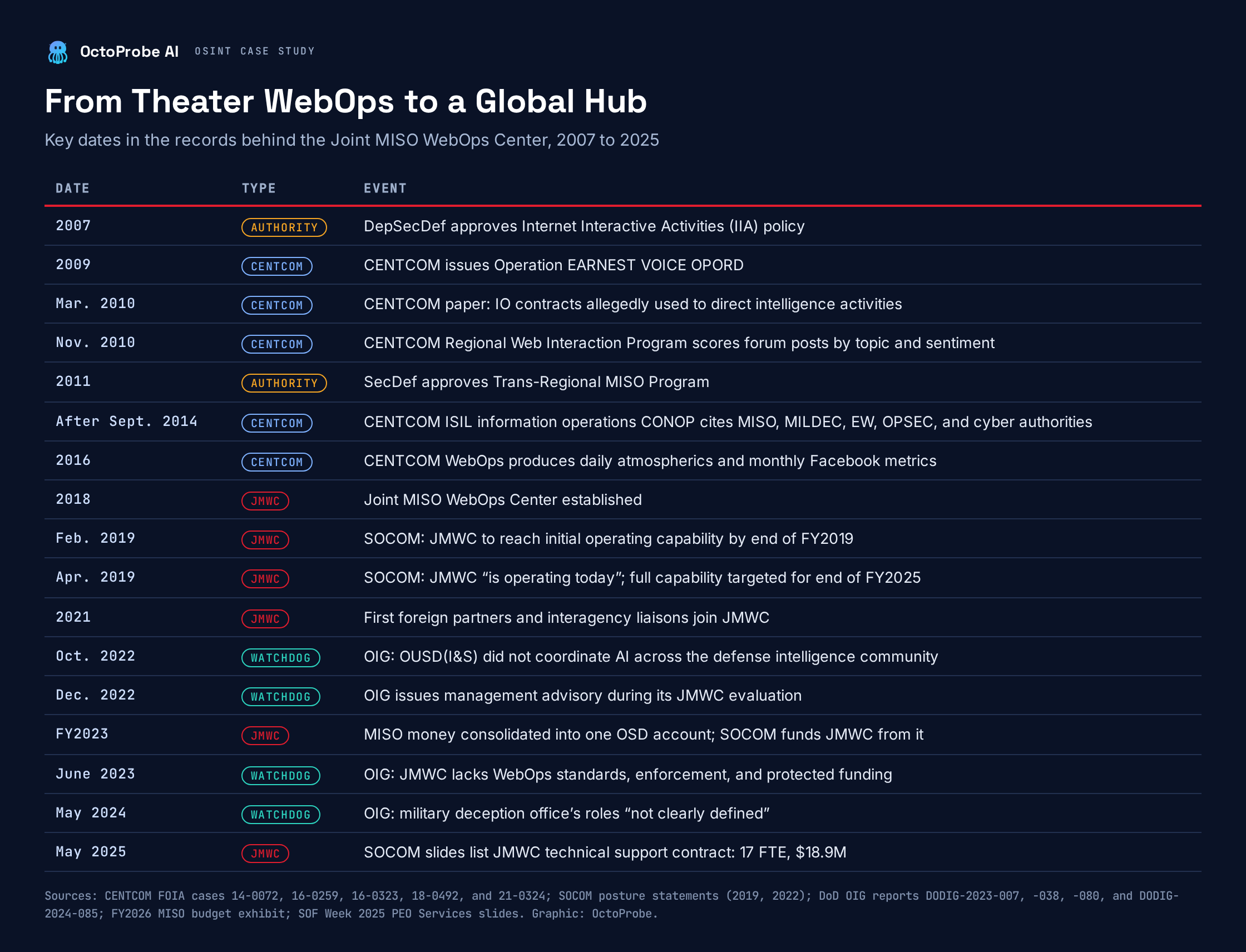
The Joint Military Information Support Operations WebOps Center (JMWC) is U.S. Special Operations Command’s hub for internet-based psychological operations. In 2019, SOCOM told Congress the center would operate “in close coordination with the interagency.” Records released under the Freedom of Information Act trace how the job looked before the center existed: Central Command (CENTCOM) web teams scoring forum posts in 2010 and logging Facebook reach in 2016, under one theater plan that stacked psychological operations, deception, electronic warfare, and cyber authorities. Three Defense Department inspector general reports then checked the coordination SOCOM promised. They found no WebOps standards, a lead office for military deception that had no formal charter for deception, and no lead office to coordinate artificial intelligence work with the Intelligence Community. A 2010 CENTCOM paper shows how influence contracts can slide into intelligence collection.
What Did SOCOM Promise Congress?
Gen. Raymond A. Thomas III, then SOCOM’s commander, laid out the mission in a February 14, 2019, statement to the Senate Armed Services Committee. “USSOCOM also now has the mission to field a transregional Military Information Support Operations (MISO) capability to address the opportunities and risks of the global information space,” he wrote. “By April of this year, the Joint MISO WebOps Center (JMWC) will be operating in close coordination with the interagency and alongside combatant command teams to provide global messaging capabilities to a broader portion of the Joint Force and beyond CVEO themes.”
The statement continued: “The JMWC will support the combatant commands with improved messaging and assessment capabilities, shared situational awareness of adversary influence activities, and the capability to coordinate internet-based MISO globally.” And: “We remain on track to achieve Initial Operating Capability in a new temporary facility by the end of FY 2019.” The National Security Archive posts a copy of the statement.
Two months later, Gen. Richard D. Clarke, Thomas’s successor, told a House Armed Services subcommittee on April 9, 2019, that “The Joint MISO WebOps Center (JMWC) is operating today, and will act in close coordination with the State Department’s Global Engagement Center and other members of the interagency.” He added, “We remain on track to achieve Full Operating Capability by the end of FY 2025.”
By April 5, 2022, Clarke told the Senate that the center “continues to coordinate our MISO conducted via the internet and actively engage foreign audiences to illuminate and counter hostile propaganda and disinformation online.” He said, “Since 2021, we have incorporated our first foreign partners and interagency liaisons within the JMWC.”
What Did Web Operations Look Like Before the JMWC?
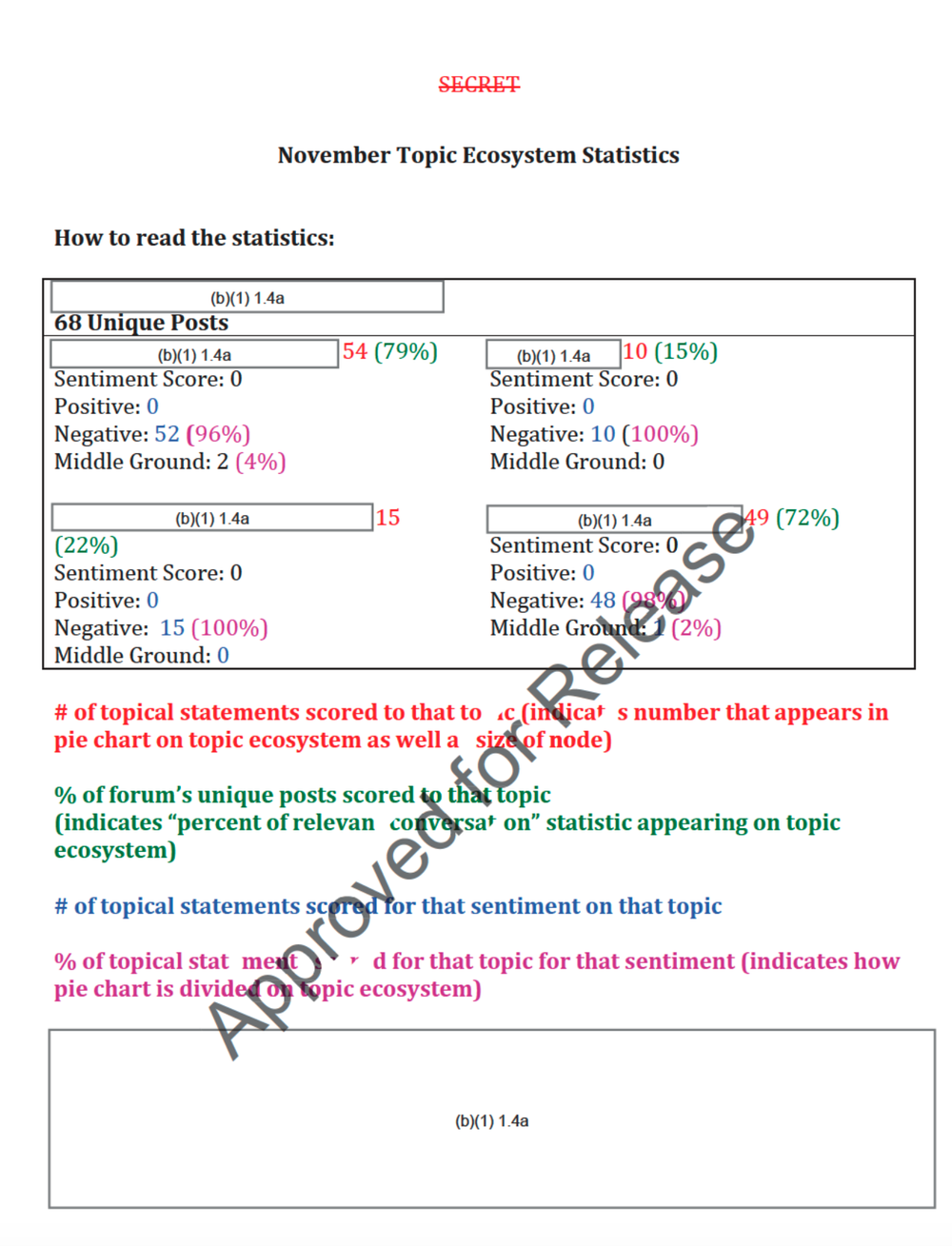
Before SOCOM took on a global mission, online influence work was run theater by theater. CENTCOM’s FOIA library holds monthly reports from a Regional Web Interaction Program (RWIP) dating to 2010, released in case 14-0072 (June 2010 report; November 2010 report).
The November 2010 report includes a page headed “November Topic Ecosystem Statistics.” It counts “68 Unique Posts” on a forum and sorts them into four topics, each label withheld under exemption (b)(1), section 1.4(a) of the classification order, which covers military plans and operations. In one topic, 54 statements were scored, covering 79% of the forum’s unique posts; the sentiment line reads “Negative: 52 (96%),” with a sentiment score of 0. A legend explains the scoring: one figure is the “% of forum’s unique posts scored to that topic,” another the “# of topical statements scored for that sentiment on that topic,” and a third the “% of topical statements scored for that topic for that sentiment (indicates how pie chart is divided on topic ecosystem).”
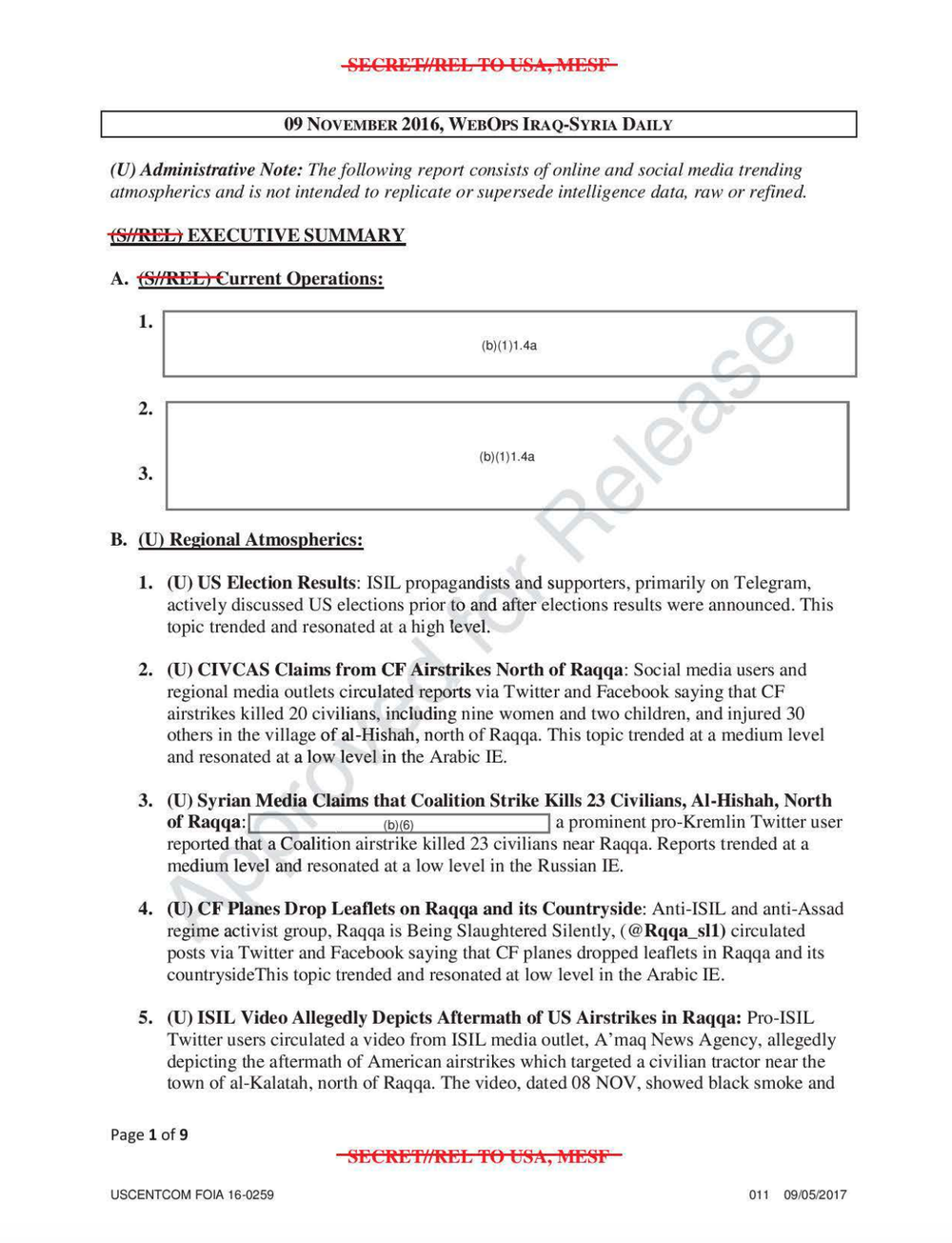
Six years later, CENTCOM’s WebOps cell was reporting on the war against the Islamic State every week and every day. Case 16-0323 includes a WebOps Weekly SITREP dated June 3, 2016. A November 9, 2016, “WebOps Iraq-Syria Daily,” released in CENTCOM FOIA case 16-0259, opens with a caveat: “The following report consists of online and social media trending atmospherics and is not intended to replicate or supersede intelligence data, raw or refined.” Each item is graded by how it spread. One “trended at a medium level and resonated at a low level in the Arabic IE.” The operations section is withheld under (b)(1) 1.4(a).
Other releases published here cover related ground: CENTCOM’s war orders, DIA files on Palestinian Islamic Jihad, and how ISIS media has survived takedowns. Those records are separate from the JMWC and CENTCOM WebOps files in this article.
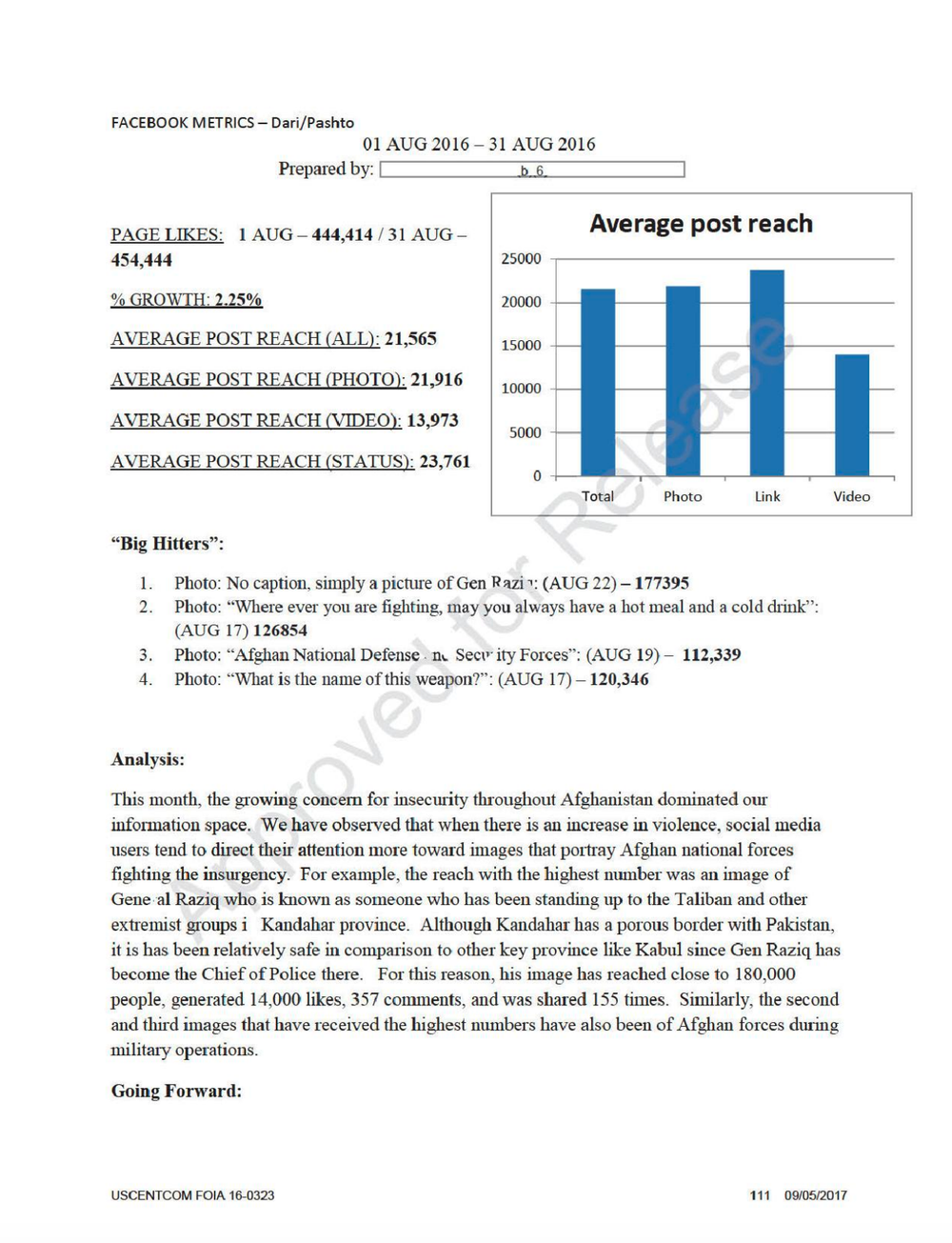
A monthly report for August 2016, released in case 16-0323, tracked a Dari- and Pashto-language Facebook page: “PAGE LIKES: 1 AUG – 444,414 / 31 AUG – 454,444,” with growth of 2.25%. Its top post was a “Photo: No caption, simply a picture of Gen Raziq,” the Kandahar police chief. The analysis says “his image has reached close to 180,000 people, generated 14,000 likes, 357 comments, and was shared 155 times.”
The cell drew congressional attention. In February 2017, the House Oversight Committee sent a letter to Defense Secretary James Mattis “regarding alleged failings in the CENTCOM WebOps unit.” The JMWC was established the next year.
Which Authorities Did a Theater Influence Plan Pull Together?
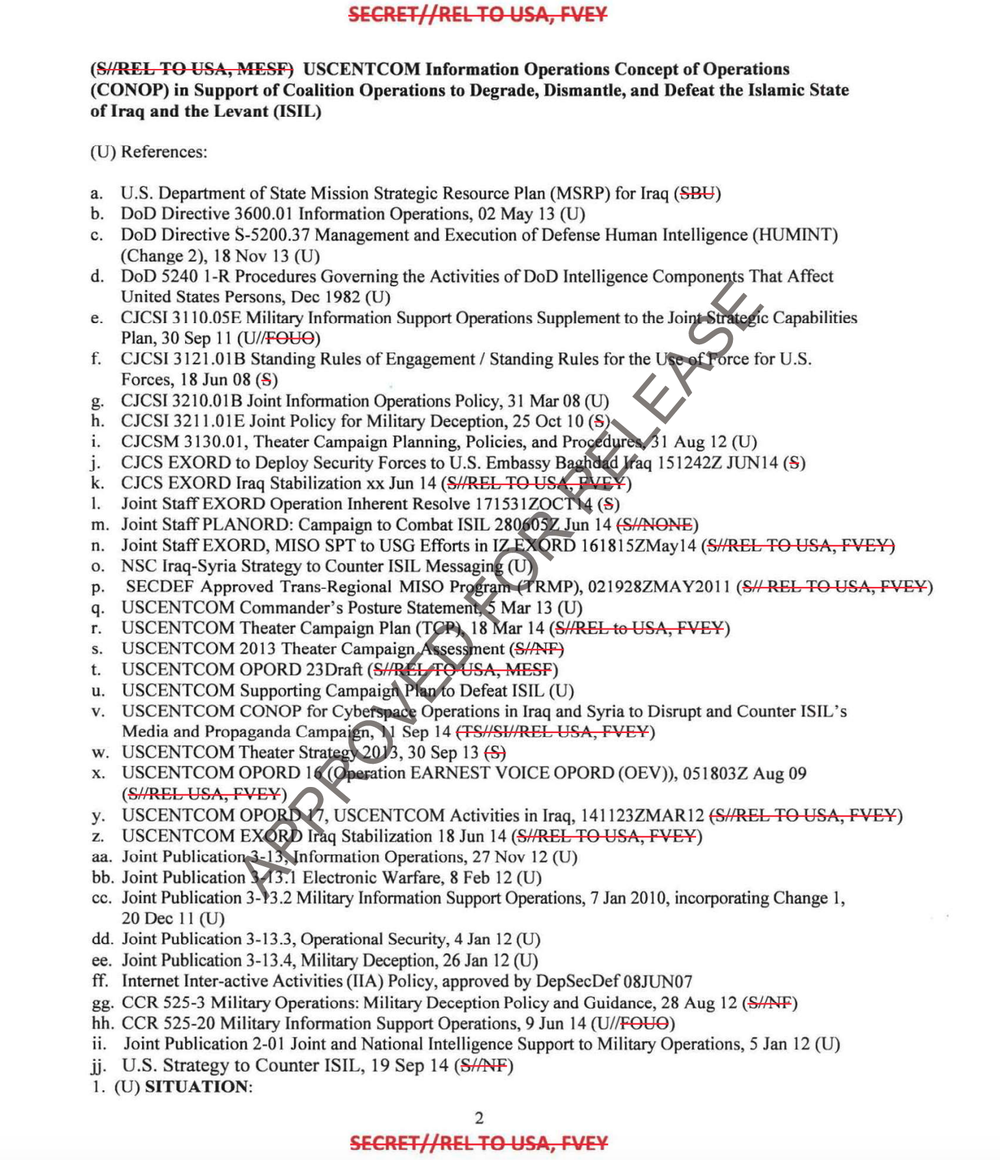
A CENTCOM plan released under FOIA shows how many separate rulebooks one theater campaign drew on. The “USCENTCOM Information Operations Concept of Operations (CONOP) in Support of Coalition Operations to Degrade, Dismantle, and Defeat the Islamic State of Iraq and the Levant (ISIL)” lists its references on page 2. CENTCOM’s FOIA library files it under case 21-0324; the page footer reads “USCENTCOM FOIA 21-0234.”
The list starts with the Pentagon’s top-level information operations rule, “DoD Directive 3600.01 Information Operations, 02 May 13,” and the Joint Staff’s psychological operations and deception policies: “CJCSI 3110.05E Military Information Support Operations Supplement to the Joint Strategic Capabilities Plan, 30 Sep 11,” “CJCSI 3210.01B Joint Information Operations Policy, 31 Mar 08,” and “CJCSI 3211.01E Joint Policy for Military Deception, 25 Oct 10.”
It then cites the authorities for online work: the “SECDEF Approved Trans-Regional MISO Program (TRMP), 021928ZMAY2011,” a “Joint Staff EXORD, MISO SPT to USG Efforts in IZ EXORD 161815ZMay14,” the “NSC Iraq-Syria Strategy to Counter ISIL Messaging,” a September 2014 “USCENTCOM CONOP for Cyberspace Operations in Iraq and Syria to Disrupt and Counter ISIL’s Media and Propaganda Campaign,” the 2009 “Operation EARNEST VOICE OPORD (OEV),” and the “Internet Inter-active Activities (IIA) Policy, approved by DepSecDef 08JUN07.” Doctrine for electronic warfare, operations security, and deception follows, along with CENTCOM’s own regulations, “CCR 525-3 Military Operations: Military Deception Policy and Guidance, 28 Aug 12” and “CCR 525-20 Military Information Support Operations, 9 Jun 14.”
The same list cites intelligence rules: “DoD Directive S-5200.37 Management and Execution of Defense Human Intelligence (HUMINT),” “DoD 5240 1-R Procedures Governing the Activities of DoD Intelligence Components That Affect United States Persons, Dec 1982,” and “Joint Publication 2-01 Joint and National Intelligence Support to Military Operations, 5 Jan 12.”
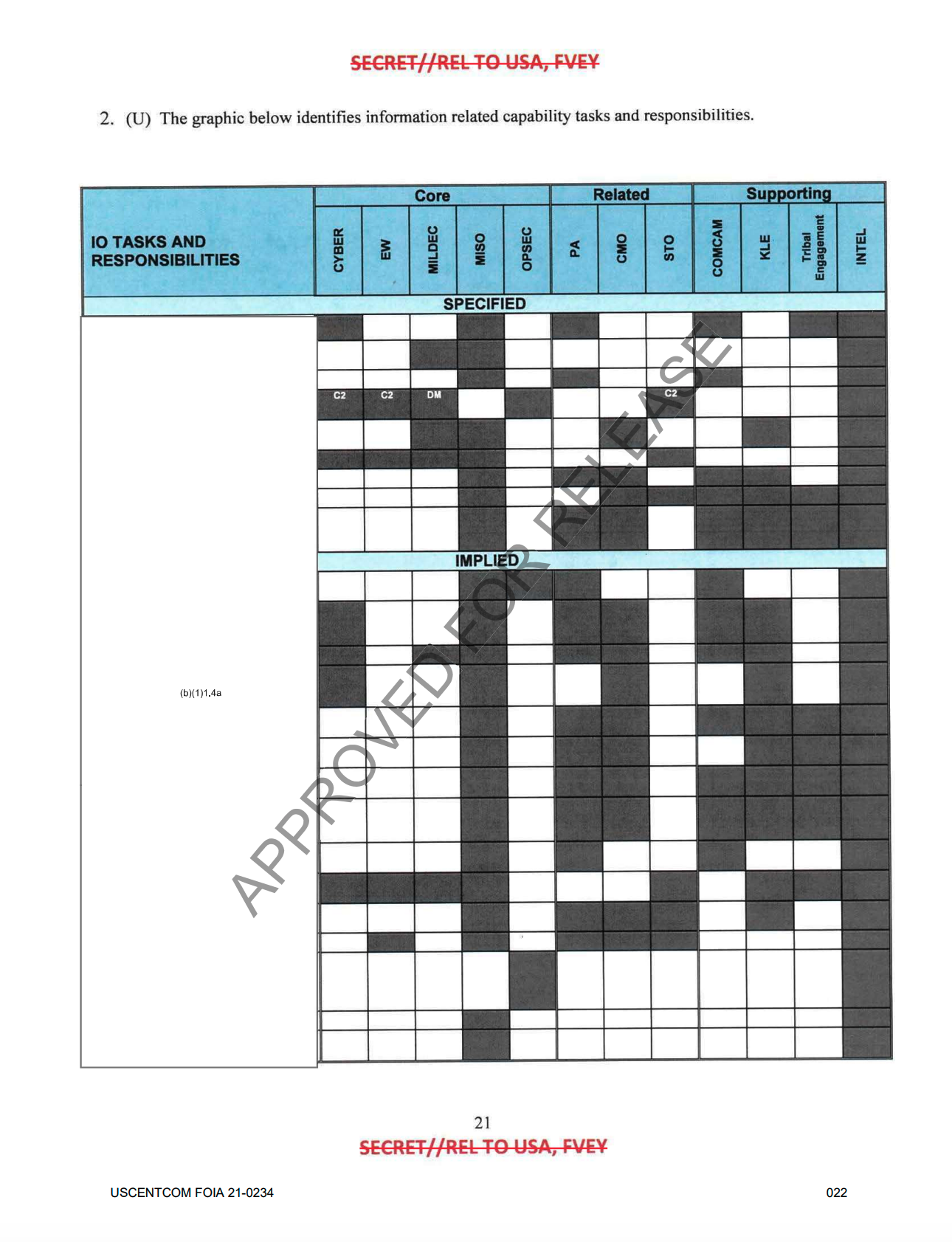
Page 21 (Bates 022) shows how the work was split. Its text reads: “The graphic below identifies information related capability tasks and responsibilities.” The grid, titled “IO TASKS AND RESPONSIBILITIES,” groups 12 columns as “Core” (cyber, electronic warfare, military deception, MISO, operations security), “Related” (public affairs, civil-military operations, and STO), and “Supporting” (combat camera, key leader engagement, tribal engagement, and intelligence). Rows fall under “SPECIFIED” and “IMPLIED” tasks. Every task name is withheld under (b)(1) 1.4(a).
Shaded cells tie each task to the capabilities responsible for it. The MISO and intelligence columns are shaded in most rows, in both sections. Other columns are shaded only in some rows. In one specified-task row, the cyber, electronic warfare, and STO cells are marked “C2” and the military deception cell is marked “DM.” The page does not define either marking.
That is the problem SOCOM described in 2019: one theater plan to bring psychological operations, deception, electronic warfare, cyber, and intelligence together, with each capability under its own doctrine and its own planners. The JMWC was pitched as a way to coordinate that work across combatant commands. SOCOM called the information space “one of the domains that challenges the Department’s command and control boundaries.”
When Does Influence Work Become Intelligence Collection?
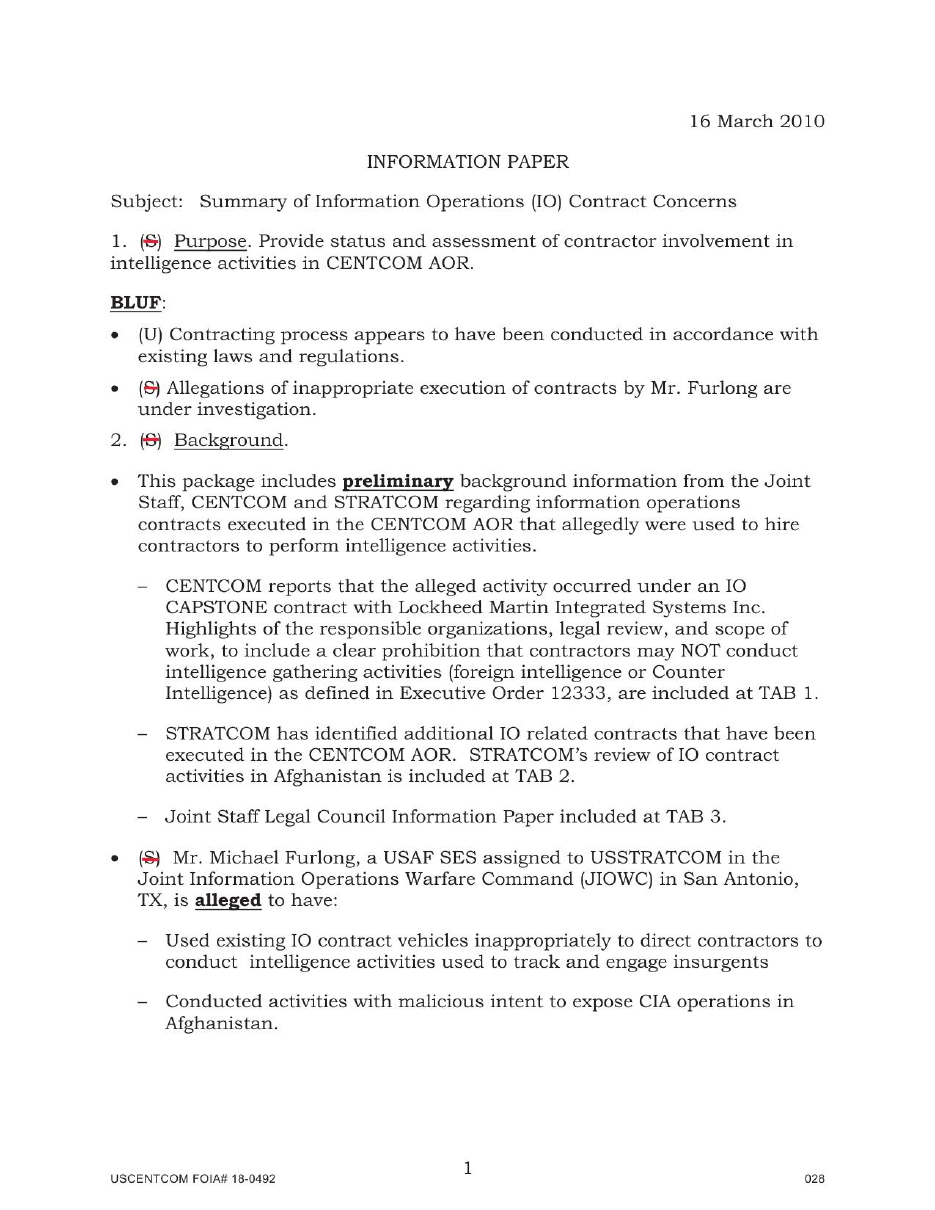
A two-page CENTCOM information paper, dated March 16, 2010, shows how an influence program can drift across that line. CENTCOM released it under FOIA case 18-0492, Bates pages 028 and 029, and it is hosted with this article. Its subject is “Summary of Information Operations (IO) Contract Concerns.” The stated purpose: “Provide status and assessment of contractor involvement in intelligence activities in CENTCOM AOR.” (p. 1, Bates 028)
The paper describes information operations contracts in CENTCOM’s area “that allegedly were used to hire contractors to perform intelligence activities.” CENTCOM said “the alleged activity occurred under an IO CAPSTONE contract with Lockheed Martin Integrated Systems Inc.” The paper says the contract package included “a clear prohibition that contractors may NOT conduct intelligence gathering activities (foreign intelligence or Counter Intelligence) as defined in Executive Order 12333.” (p. 1)
It names the official at the center of the allegations: “Mr. Michael Furlong, a USAF SES assigned to USSTRATCOM in the Joint Information Operations Warfare Command (JIOWC) in San Antonio, TX, is alleged to have:” The two allegations: “Used existing IO contract vehicles inappropriately to direct contractors to conduct intelligence activities used to track and engage insurgents” and “Conducted activities with malicious intent to expose CIA operations in Afghanistan.” (p. 1)
The interim assessment split the contract from its use. “Contracting process appears to have been conducted in accordance with existing laws and regulations.” “Statement of Work (SOW) underwent multiple legal reviews.” But “Investigations are focused on Mr. Furlong exceeding his authority in execution of legally sufficient contract vehicles.” The investigators: “Investigation organizations include the DoD Inspector General through Defense Criminal Investigation Service (DCIS) and the Federal Bureau of Investigation (FBI). Additionally, the Air Force Office of Special Investigations (AF OSI) may open an investigation pending a response to their Request for Information.” (p. 2, Bates 029)
One recommended action reached beyond the case: “Review Information Operation and Voice Programs purpose, scope and execution to identify any ambiguities/conflicts with intelligence efforts.” (p. 2) The preparer’s name is withheld under (b)(6).
The public record fills in what followed. The New York Times reported in May 2010 that the contractor network was still supplying information. In October 2010 it reported the results of a Pentagon inquiry. The Times reported that the investigation concluded Furlong set up an unauthorized intelligence network “to collect information in both countries — some of which was fed to senior generals and used for strikes against militant groups — while masking the entire operation as a more benign information operations campaign.” According to Col. David Lapan, a Pentagon spokesman, the inquiry concluded that “further investigation is warranted of the misleading and incorrect statements the individual made” about the program’s legality. NPR reported that Furlong “denies the charges saying his operation was approved at the highest levels and that he was never interviewed by investigators.”
In September 2011, the Associated Press reported that Furlong and his supervisor, Mark Johnson, “resigned in July after the Air Force inspector general told the men they'd face official censure for how they ran an information-gathering network in Afghanistan.” Furlong wrote in his resignation letter: “After 17 months of DOD investigations and an FBI investigation, it was determined that no criminal laws were broken.” The AP said “inquiries continue by the U.S. Air Force Office of Special Investigations and the Pentagon's Defense Criminal Investigative Service.”
The episode lines up with the authorities in CENTCOM’s later ISIL plan. That plan cites the 2007 Internet Interactive Activities policy for online work and, separately, the human intelligence directive and the intelligence-oversight procedures that carry out Executive Order 12333. The 2010 paper shows what happened when the boundary between those two lanes rested on contract language and an individual’s conduct.
How Big Is the JMWC’s Footprint?
The money now runs through one account. The Pentagon’s fiscal 2026 budget exhibit for MISO says: “In FY 2023, the Department transferred funds previously programmed and funded by the Military Departments and US Special Operations Command (USSOCOM) to capitalize the central MISO account.” And: “The USSOCOM executes directly from the centralized MISO account for the Joint MISO Web Operations Center (JMWC).” The account totaled $252.1 million in fiscal 2024 actual spending and $250.1 million enacted for fiscal 2025, with $209.4 million requested for fiscal 2026. The exhibit does not break out the JMWC’s share.
A 2023 Air Force environmental assessment describes a permanent home. It covers “Construction of the new permanent MISO facility on MacDill AFB” in Tampa, “an approximately 100,000 square foot two-to-three-story office building sufficient for approximately 850 MISO personnel working there.” The assessment does not name the JMWC.
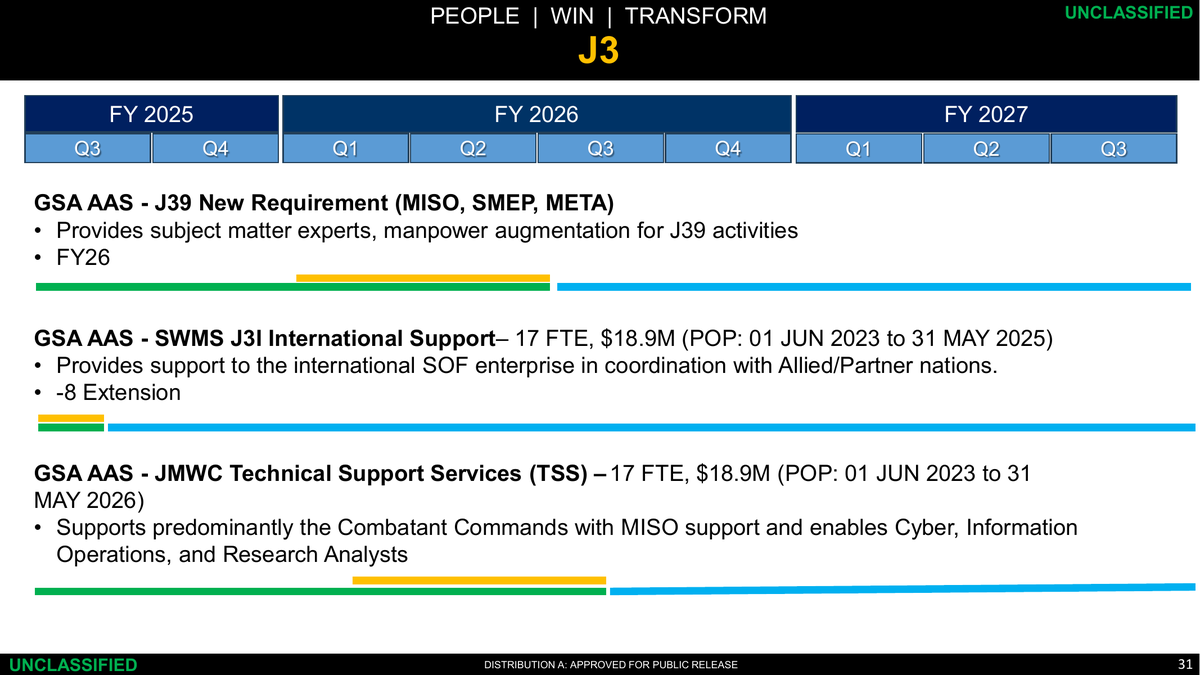
SOCOM’s own acquisition slides name the contract support. A briefing by Pete Greany, SOCOM’s program executive officer for services, at SOF Week 2025 places the JMWC in the J3 program manager’s portfolio on its organization chart. Slide 31 lists “GSA AAS - JMWC Technical Support Services (TSS) – 17 FTE, $18.9M (POP: 01 JUN 2023 to 31 MAY 2026),” which “Supports predominantly the Combatant Commands with MISO support and enables Cyber, Information Operations, and Research Analysts.” The same slide lists a new requirement for SOCOM’s J39 office, “Provides subject matter experts, manpower augmentation for J39 activities.”
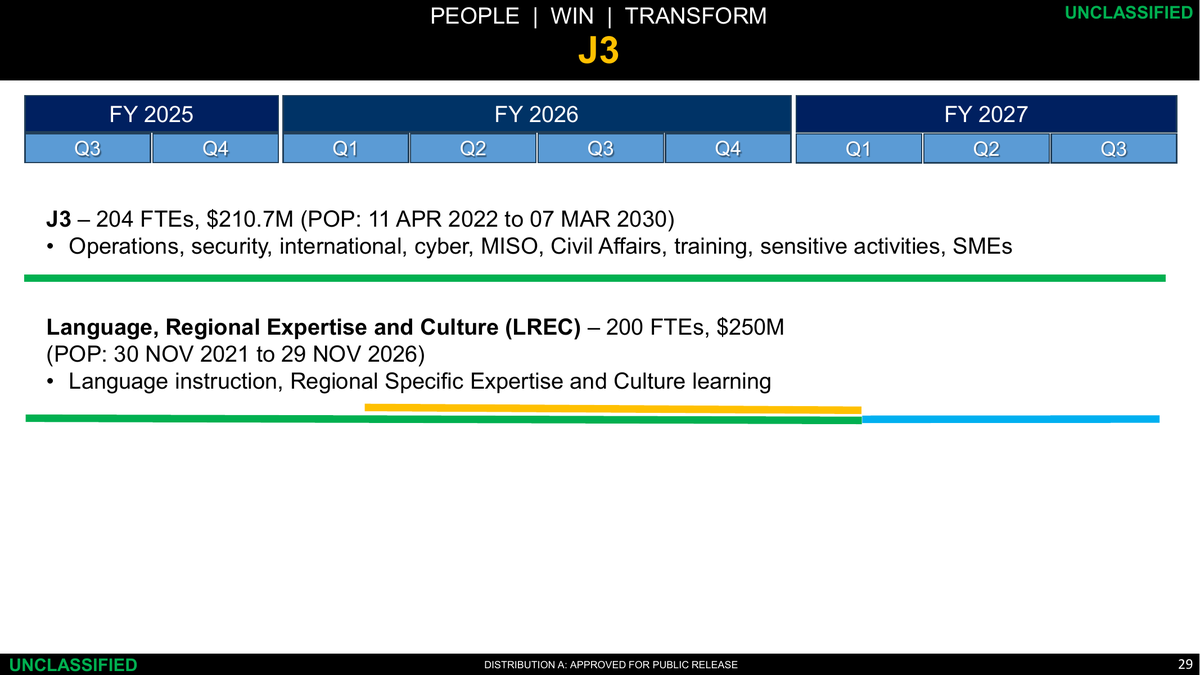
Slide 29 lists a larger J3 support contract: “J3 – 204 FTEs, $210.7M (POP: 11 APR 2022 to 07 MAR 2030),” covering “Operations, security, international, cyber, MISO, Civil Affairs, training, sensitive activities, SMEs.”
What Did the Inspector General Find at the JMWC?
The inspector general reviewed the center twice. A management advisory, DODIG-2023-038, is listed in the office’s FOIA reading room with a December 15, 2022, date. The full evaluation, DODIG-2023-080, dated June 6, 2023, is classified; the office released a redacted summary and a public summary page.
The summary says “The JMWC was established in 2018 [REDACTED].” It describes the center as providing “facilities and technical support, as well as some additional capabilities, to MISO Web Operations (WebOps) teams from participating combatant commands.”
The finding: “We concluded that the JMWC has satisfied the basic needs of the combatant commanders while conducting Internet-based MISO but is not providing some important capabilities related to new technologies, cybersecurity, and the ability to operate nonstop.” The cause: “key Government positions responsible for delivering these capabilities were unfilled or eliminated, limiting both oversight and support capacity at the JMWC.”
The report says “the JMWC lacks a set of standards for the conduct of WebOps and has no mechanism for enforcing such standards by the WebOps teams.” It blames the policy and intelligence undersecretaries for “providing neither sufficient MISO WebOps policy nor proactive oversight” and says the special operations assistant secretary “has not delegated any entity with sufficient oversight authority to ensure MISO WebOps teams’ compliance to policy and guidelines.”
On money, the consolidated account “requires that the JMWC Core compete with the MISO WebOps teams it supports for the same funds.” The office recommended that the policy undersecretary “establish parameters for conducting non-attributed operations, and develop a quality assurance oversight process for non-attributed MISO and MISO series.” A second recommendation is redacted. The intelligence undersecretary “did not respond to recommendation 2. Therefore, the recommendation is unresolved.”
What Did the Military Deception Evaluation Find?
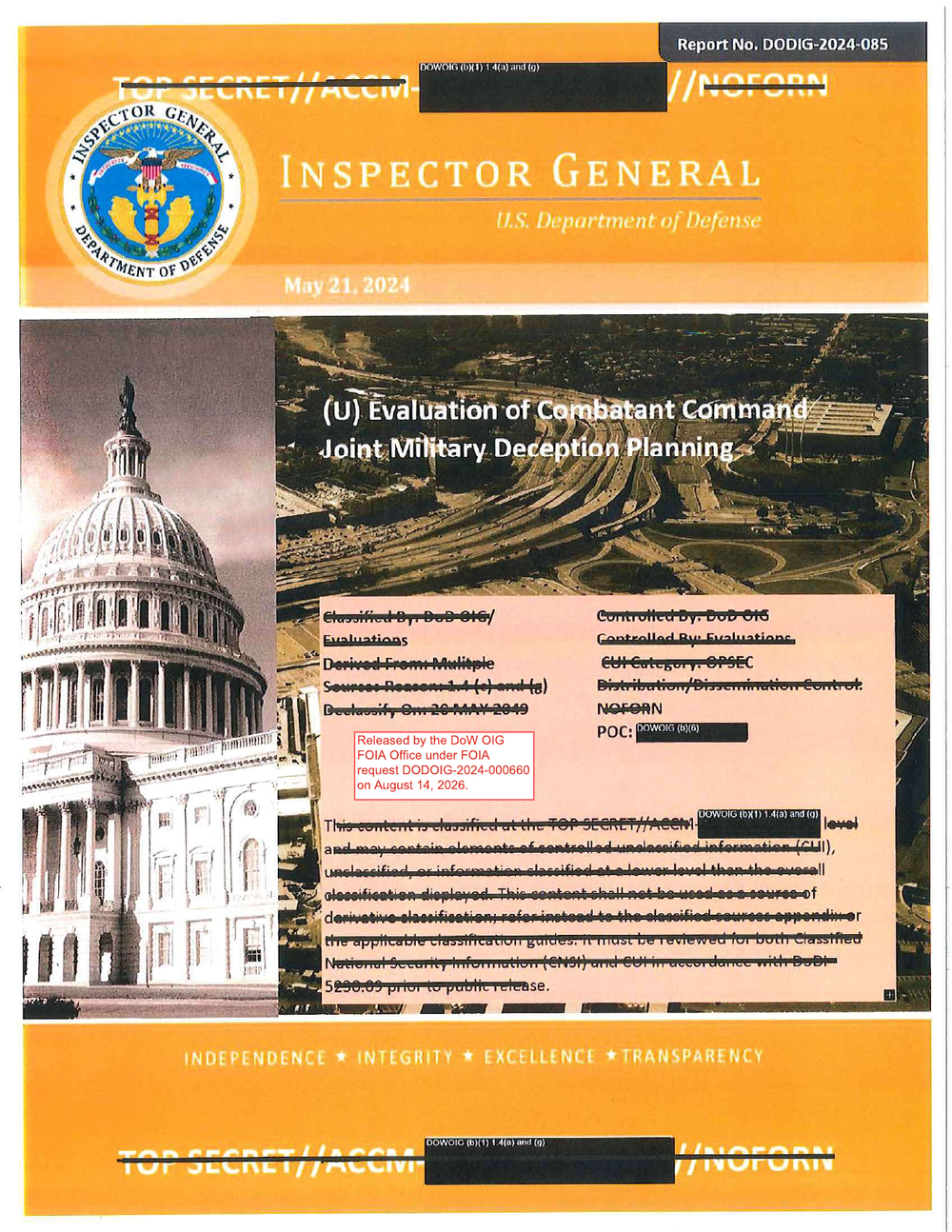
DODIG-2024-085, dated May 21, 2024, was released under the Freedom of Information Act in case DODOIG-2024-000660, from a request received July 31, 2024. The release stamp is dated August 14, 2026. The objective: “to determine the extent to which the combatant commands have effectively conducted military deception (MILDEC) planning in support of current and future operations.” (PDF p. 3) Fieldwork ran “from October 2022 through March 2024.” (PDF p. 32)
The report defines military deception as “actions executed to deliberately mislead adversary military, paramilitary, or violent extremist organization decision makers.” It notes that “Joint MILDEC requires Secretary of Defense approval and operates under the authorities derived from an execute order for the supported operation.” The Joint Staff’s J-39 office “is the single point of contact through which the combatant commands staff their MILDEC concepts, plans, and activities.” (PDF p. 3)
Evaluators credited the Joint Staff: it “provided appropriate oversight of the Joint MILDEC program, including review, approval, and deconfliction boards.” The next sentence begins “However, we determined that the DoD's Joint MILDEC program” and is then blacked out. (PDF p. 3) Policy bars using deception for other agencies without approval; it “expressly prohibits the use of deception activities to support non-DoD Federal Department or Agency (NDFDA) activities unless approved.” (PDF p. 11)
The unredacted finding headings are blunt. One reads “The Roles and Responsibilities of the Office of Primary Responsibility for Military Deception Are Not Clearly Defined.” The report says the responsibility moved to the Influence and Perception Management Office in 2023 and that, “As of the date of this report, Influence and Perception Management Office did not have a formal charter for deception; however, it was developing a deception management program.” (PDF p. 23) Another heading: “CCMDs Generally Have Little Joint MILDEC Capacity Within Their Staffs.” (PDF p. 25)
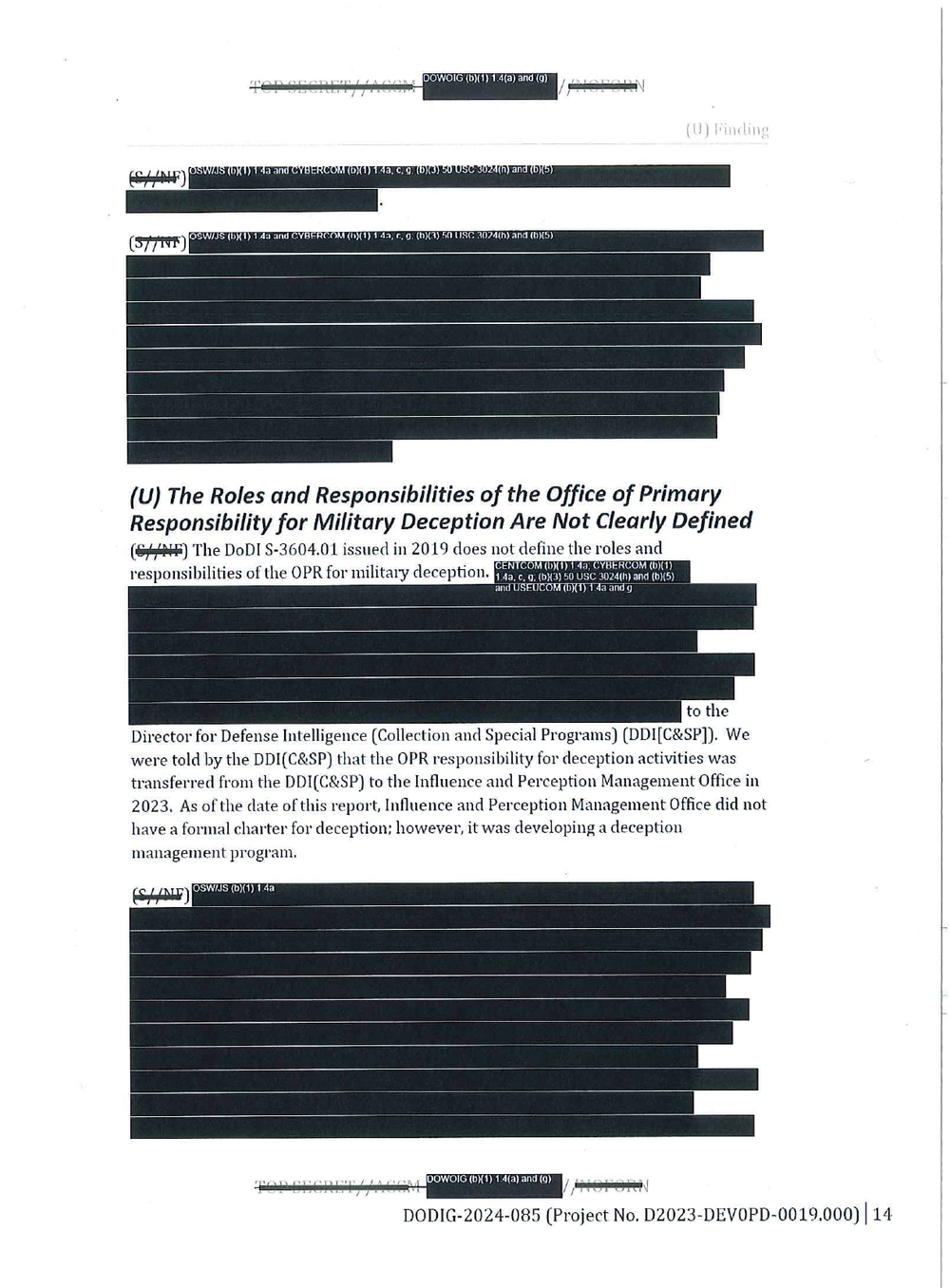
The office recommended that the intelligence undersecretary update the classified deception instruction “to clarify the roles and responsibilities of the military deception office of primary responsibility.” The undersecretary “did not respond to the recommendation in the report. Therefore, the recommendation is unresolved.” (PDF p. 28) A second recommendation, to “Gather Joint MILDEC staffing requirements and practices from the CCMDs and assess methods to surge MILDEC planners to CCMDs facing facility limitations,” was also unresolved because the Influence and Perception Management Office “did not provide comments to the recommendation.” (PDF p. 29)
The problems were not new. “In the past 15 years, the DoD has commissioned three studies to review the Department’s MILDEC program,” the report says (PDF p. 34), and a 2024 RAND study “echoed the key themes made in the previous two studies.” (PDF p. 35) Redactions throughout cite exemption (b)(1) under sections 1.4(a), (c), and (g) of the classification order, and (b)(3) with 50 U.S.C. 3024(h), the statute protecting intelligence sources and methods. Several redaction labels are attributed to U.S. Cyber Command.
Where Did Coordination With the Intelligence Community Break Down?
A third evaluation looked at the intelligence side. DODIG-2023-007, a joint review with the National Security Agency’s inspector general dated October 17, 2022, was released under FOIA in case DODOIG-2023-000181, from a request received November 21, 2022. Its release stamp cites request DODOIG-2024-000500 and December 9, 2024. The evaluators “jointly assessed the NSA’s integration of artificial intelligence (AI) into signals intelligence (SIGINT) operations.” (PDF p. 3)
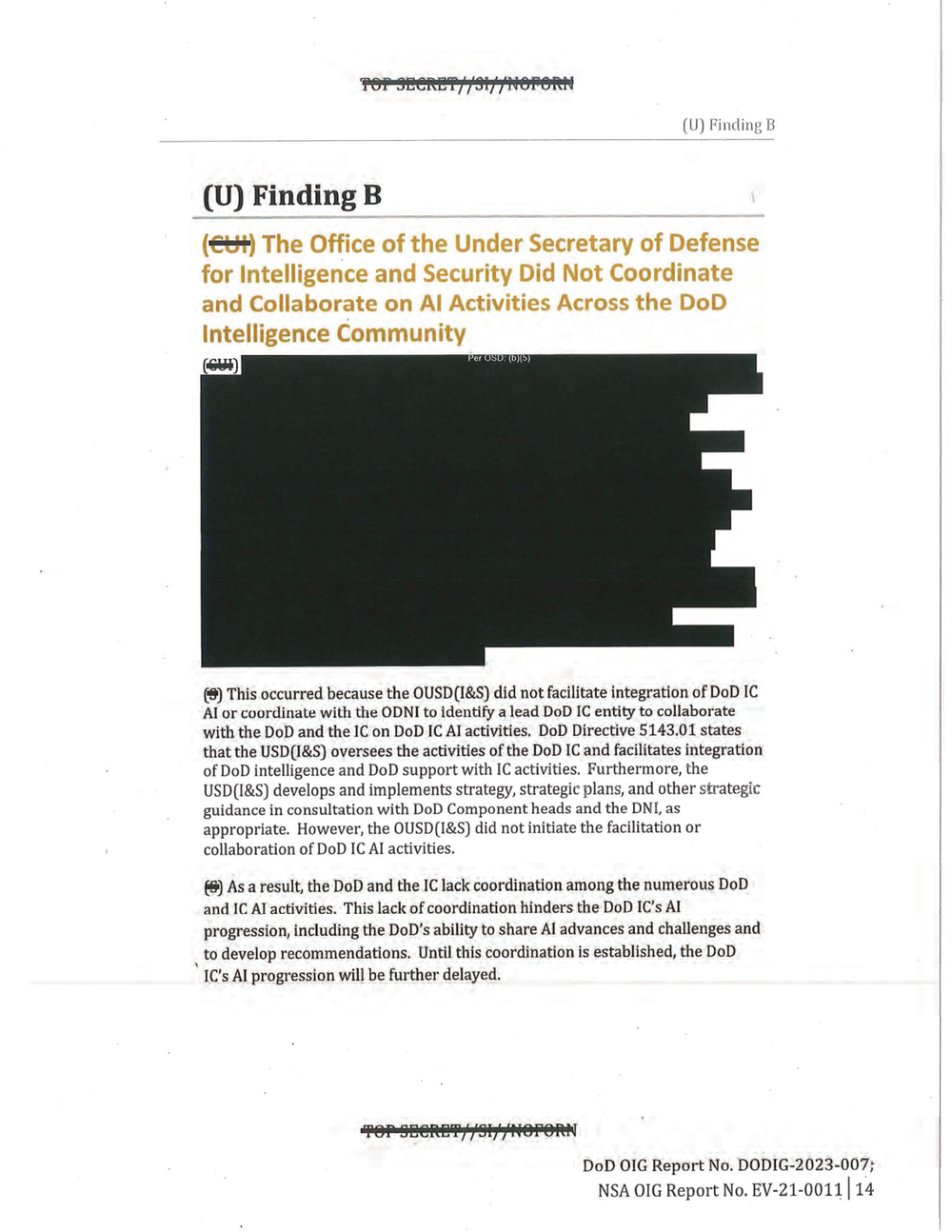
Finding B is titled “The Office of the Under Secretary of Defense for Intelligence and Security Did Not Coordinate and Collaborate on AI Activities Across the DoD Intelligence Community.” The office “did not facilitate integration of DoD IC AI or coordinate with the ODNI to identify a lead DoD IC entity.” The result: “As a result, the DoD and the IC lack coordination among the numerous DoD and IC AI activities.” (PDF p. 23)
One official, the report says, “was not aware that the JAIC could not report on DoD IC AI activities,” even though, “according to JAIC officials, the JAIC does not have authorities and resources to effectively work in the IC environment.” (PDF p. 24) The intelligence office later said it would name the Pentagon’s digital and AI office as coordinator, because “although the OCDAO is not an IC entity, it is the optimal organization to coordinate and harmonize DoD AI efforts with the IC.” The Office of the Director of National Intelligence cautioned that it “does not want DoD IC elements to become confused about reporting chains.” (PDF p. 27)
Set side by side, the promises and findings look like this.
| What was promised or assigned | What evaluators found |
|---|---|
| JMWC to operate “in close coordination with the interagency” (Thomas, 2019) | No WebOps standards or enforcement; no entity delegated “sufficient oversight authority” (DODIG-2023-080) |
| “Shared situational awareness of adversary influence activities” (Thomas, 2019) | Center “is not providing some important capabilities related to new technologies, cybersecurity, and the ability to operate nonstop” (DODIG-2023-080) |
| Joint Staff J-39 as the “single point of contact” for deception plans (DODIG-2024-085) | Deception office’s roles “not clearly defined”; the Influence and Perception Management Office “did not have a formal charter for deception” (DODIG-2024-085, PDF p. 23) |
| Undersecretary for intelligence oversees DoD intelligence and its integration with the IC (DODIG-2023-007) | Office “did not coordinate and collaborate” on AI across the DoD Intelligence Community (DODIG-2023-007, PDF p. 23) |
| Intelligence undersecretary asked to respond to recommendations | No response to JMWC recommendation 2 or the deception instruction recommendation; both unresolved |
What Public Controversies Involve MISO?
Printed products have drawn scrutiny too. In September 2017, U.S. forces dropped leaflets in Afghanistan’s Parwan province that showed a dog carrying the Taliban flag. CBS News and the Associated Press reported that the flag “has Islamic verses inscribed on it.” Maj. Gen. James Linder, the special operations commander in Afghanistan, said in a statement that “the design of the leaflets mistakenly contained an image highly offensive to both Muslims and the religion of Islam” and offered his “sincerest apologies for this error.” “There is no excuse for this mistake,” he said. “I am reviewing our procedures to determine the cause of this incident and to hold the responsible party accountable.” Officials with the Resolute Support mission “said they are reviewing their policies to ensure this does not happen again.”
In August 2022, Graphika and the Stanford Internet Observatory published “Unheard Voice,” an analysis of accounts Twitter and Meta removed that summer. The report found “an interconnected web of accounts on Twitter, Facebook, Instagram, and five other social media platforms that used deceptive tactics to promote pro-Western narratives in the Middle East and Central Asia.” It noted that some accounts linked to two websites that “say they are sponsored by the U.S. Central Command (CENTCOM).” The report says that “neither company has publicly attributed the activity to any entity or organization.”
In June 2024, Reuters reported that the military ran a campaign in 2020 and 2021 to undermine confidence in China’s Sinovac vaccine in the Philippines. In a republished version, Reuters said the Pentagon “ran the program through the military's psychological operations centre in Tampa, Florida.” It reported that “In trailers and squat buildings at a facility on Tampa's MacDill Air Force Base, US military personnel and contractors would use anonymous accounts on X, Facebook and other social media to spread what became an anti-vax message.” A Pentagon spokeswoman said the military “uses a variety of platforms, including social media, to counter those malign influence attacks aimed at the US, allies, and partners.” Reuters did not name the JMWC.
Approval rules have since moved in more than one direction. Three former Pentagon officials told Reuters that in peacetime the Pentagon “needed approval of embassy officials before conducting psychological operations in a country,” until a secret 2019 order from then-Defense Secretary Mark Esper. That order, Reuters reported, elevated competition with China and Russia, “enabling commanders to sidestep the State Department when conducting psyops against those adversaries.” In December 2019, Congress affirmed that “the Secretary of Defense is authorized to conduct military operations, including clandestine operations, in the information environment” and that such a clandestine operation “shall be considered a traditional military activity” under the National Security Act. In 2023, the inspector general recommended a quality assurance oversight process for non-attributed MISO, as noted above.
The Records
| Record | Date | Source |
|---|---|---|
| DODIG-2024-085, Evaluation of Combatant Command Joint Military Deception Planning | May 21, 2024 | FOIA case DODOIG-2024-000660; hosted |
| DODIG-2023-007, Joint Evaluation of the NSA’s Integration of Artificial Intelligence | Oct. 17, 2022 | FOIA case DODOIG-2023-000181; hosted |
| CENTCOM information paper, Summary of IO Contract Concerns | Mar. 16, 2010 | CENTCOM FOIA 18-0492; hosted |
| DODIG-2023-080, Evaluation of SOCOM’s JMWC (redacted summary) | June 6, 2023 | DoD OIG |
| DODIG-2023-038, Management Advisory on the JMWC | Dec. 15, 2022 | DoD OIG reading room |
| CENTCOM IO CONOP against ISIL | After Sept. 2014 | CENTCOM FOIA 21-0324 |
| RWIP monthly reports, June and November 2010 | 2010 | CENTCOM FOIA 14-0072 |
| WebOps Iraq-Syria Daily | Nov. 9, 2016 | CENTCOM FOIA 16-0259 |
| WebOps Weekly SITREP | June 3, 2016 | CENTCOM FOIA 16-0323 |
| Monthly report with Facebook metrics | Aug. 2016 | CENTCOM FOIA 16-0323 |
| PEO Services, SOF Week 2025 briefing | May 2025 | SOCOM |
| FY2026 MISO budget exhibit (OP-5) | June 2025 | DoD Comptroller |
Frequently Asked Questions
What is the Joint MISO WebOps Center?
It is a SOCOM-funded center, established in 2018, that hosts web operations teams from participating combatant commands and gives them facilities, technical support, and some additional capabilities for internet-based military information support operations, according to the Defense Department inspector general.
Where is it, and how is it paid for?
The inspector general does not publish its location. A 2023 Air Force environmental assessment describes a planned permanent MISO building at MacDill Air Force Base in Tampa for about 850 people. Since fiscal 2023, SOCOM has funded the center from a single Pentagon MISO account managed by the assistant secretary for special operations and low-intensity conflict.
What did the inspector general find?
In June 2023 it found the center met combatant commanders’ basic needs but lacked capabilities tied to new technologies, cybersecurity, and round-the-clock operations; had no WebOps standards or enforcement mechanism; and had to compete for money with the teams it supports.
What is DODIG-2024-085?
A May 21, 2024, inspector general evaluation of how combatant commands plan joint military deception. A redacted copy was released under the Freedom of Information Act in case DODOIG-2024-000660 and is hosted with this article.
Who was Michael Furlong?
An Air Force senior executive at U.S. Strategic Command’s Joint Information Operations Warfare Command. A March 16, 2010, CENTCOM information paper says he was alleged to have used information operations contracts to direct intelligence activities. He resigned in 2011, writing that investigators found no criminal laws were broken, according to the Associated Press.
